
Walking Hand in Hand

Prepared with concrete and pragmatic questions, members of a media delegation from the Republic of the Congo toured the cities of Yunfu and Zhaoqing in Guangdong Province from 16 to 22 November 2025. They visited production workshops, explored research institutes, toured beautiful villages and discovered archaeological sites, searching for the keys to Chinese modernisation in its many dimensions.
Throughout the mission, their notebooks were filled with notes, reflecting their observations and reflections. “When I return home, I will faithfully report everything I have seen and heard here,” said Rosine Mathilde Bouamoutala, a journalist with La Nouvelle République.
China and the Republic of the Congo, linked by a strong strategic partnership, continue to support each other and work towards win-win cooperation. The two countries have achieved fruitful results in infrastructure, energy, health and education. China is the Republic of the Congo’s largest trading partner and one of its main sources of foreign direct investment.
A pioneer in reform and opening up, Guangdong Province is a true microcosm of Chinese modernisation: its experiences and innovations powerfully illustrate the potential of this model. The promotion of Chinese modernisation opens up a new, original and inspiring path to modernisation for developing countries, including the Republic of the Congo.
The visit allowed the Congolese delegation to observe the modernisation process up close. Their aim was to identify approaches that could be adapted to the Congolese context, enabling the sharing of development opportunities and progress along the path to modernisation.
Decoding quality development
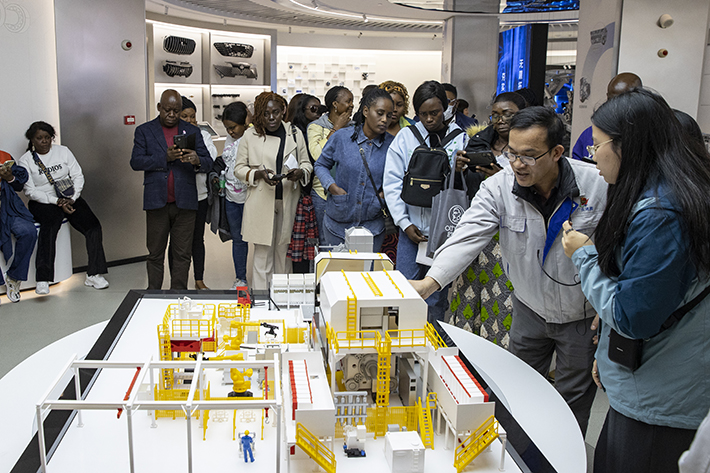
Throughout their visit, the Congolese delegation immersed themselves in the heart of China’s industry, observing how local companies are reinventing themselves to meet the demands of modernisation.
In Jinli, a town in Zhaoqing City, the delegation first visited the Jinli branch of Guangdong Hongtu Technology. In the exhibition hall, the die-cast automotive parts immediately drew their attention. The company’s director, Li Jianyang, presented its development and efforts in technological innovation, offering a striking example of the successful transformation of a traditional sector.
At the workshops of Educe Home Furnishing Technology in Zhaoqing, four robotic arms worked in synchronisation amid the hum of machinery, capturing the interest of the visitors and prompting numerous photographs.
The delegation also explored the emerging new energy sector. In Zhaoqing, they visited the industrial park of XPENG, a new energy vehicle company. They listened to engineers explain research and development and applications in autonomous driving, before climbing aboard themselves for a test drive. They were all surprised to learn that XPENG could roll a complete car off the production line in just 90 seconds.
At the provincial level, Guangdong remains firmly committed to the development of manufacturing. According to data released at the press conference on Guangdong’s economic and social development during the 14th Five-Year Plan (2021-2025), held on 6 November 2025, production of new energy vehicles reached 3.618 million units, accounting for a quarter of the national total, while production of industrial robots reached 247,000 units, representing 43.5 percent of China’s output. At the same time, Guangdong has already established nearly 2,100 technology business incubators and innovation spaces.
Appealing surroundings
In Zhaoqing, the picturesque Qixingyan site stretches across the heart of the city like a vast landscape painting. The sparkling reflections on the lake, the gentle breeze and the natural tranquillity attracted the members of the delegation, who eagerly photographed the enchanting setting. For several years, the city of Zhaoqing has been undertaking major renovation efforts here, modernising infrastructure, improving service quality and restoring landscapes. In January 2020, it was promoted to a AAAAA national tourist site, the highest distinction in China.
Congolese journalists were fascinated by the karst formations, showing keen interest in the history of the rock inscriptions, biodiversity protection measures and the day-to-day management of the area. Chrislin Vivien Sita Nsemi, head of IT and community manager at Télé Congo, emphasised that the Qixingyan site is “a model for the protection and enhancement of natural heritage.” Citing his country’s Odzala-Kokoua National Park, he added: “We can draw inspiration from China’s effective organisation of tourism management and extensive use of green technologies. For its part, China could observe our model of protection based on the participation of local communities. Our two countries share the same ambitions: to develop sustainable tourism and preserve the natural heritage.”
At Mount Dinghu, the delegation members wandered through lush vegetation, witnessing first-hand the harmony between people and nature that defines the Chinese vision. “China has done remarkable work in environmental protection. Faced with the global challenge of climate change, it is a true model that we should all draw inspiration from as we strive to pass on a healthy environment to future generations,” Lucie Prisca Condhet Nzinga, a journalist at Télé Pointe-Noire, told ChinAfrica.
In recent years, Guangdong has achieved coordinated progress in reducing emissions, combating pollution, expanding green spaces and promoting sustainable growth. The province’s soil and water conservation rate has risen to 90.7 percent, while 7,200 km of ecological corridors now connect mountains, rivers and the sea, creating a seamless network of protected landscapes.
Scenic beauty is not confined to tourist sites; it can also be discovered in villages. The protection of the environment and the preservation of cultural heritage left a lasting impression on the Congolese journalists. Thanks to a model combining government leadership with support from public enterprises and private investment, the village has become a shining example of the coordinated urban-rural development programme, a major strategy launched across the province at the end of 2022. As a result, the gap in disposable income per capita between urban and rural areas has narrowed from 2.49 in 2020 to 2.31 in 2024, reflecting more balanced development across the province.
The delegation also learned about the essential role of technology in rural revitalisation. In Xinxing County in Yunfu, the journalists visited the Wens Group Research Institute. Its digital management systems and modern livestock farming technologies made a deep impression on the delegation.
Delving into history and culture
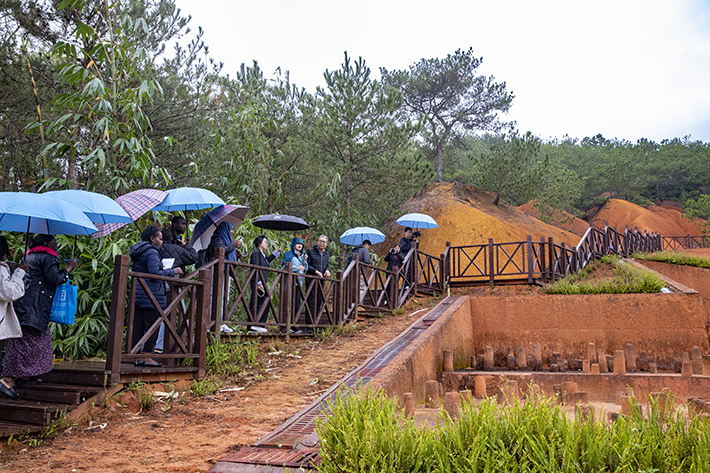
Beyond industrial and social development, the delegation also enjoyed a memorable cultural encounter at the Modaoshan archaeological site in Yunan County, Yunfu. Walking on this red earth, the journalists embarked on a journey through time, discovering traces of the ancient inhabitants of Lingnan dating back 600,000 to 800,000 years, creating a vivid dialogue between past and present.
Guided by site specialists, the delegation explored the origins of Lingnan’s prehistoric culture, gaining a deeper appreciation of both the depth of Chinese civilisation and the diversity of its regional roots. At every stop, the journalists listened closely to the explanations, took photographs, asked questions and engaged in discussions on issues related to the preservation of cultural heritage.
Josepha Saprina Bouity, a journalist with Radio Brazzaville, said she was deeply impressed: “It’s extraordinary to imagine that human beings lived here hundreds of thousands of years ago! These stone tools are not only the historical heritage of Yunfu, but that of all humanity.”
According to her, the Republic of the Congo also has significant prehistoric sites, but excavations there are not carried out with the same depth. In China, she noted, archaeology is strongly supported because culture is valued, which in turn enriches research. The visit left her deeply inspired: “I want to share this experience so that visitors can better appreciate the richness of African civilisation.”
For Paule Valya Nkodia Ngohan, a journalist at Télé Congo, this visit was of great educational value: “This experience reminded me of my classes on the origins of humanity. China-Africa cooperation in the field of dialogue between civilisations has immense potential.”
After the visits, the journalists also took part in a paper-cutting workshop, which is listed as part of China’s intangible cultural heritage. The atmosphere was warm and friendly, with lively exchanges with the artisans; everyone left with a smile. The participants also tasted local specialities, including Clausena lansium juice and vinegar without seeds from Yunan, which were very popular.
Allegra De Rachelia Maposso, a journalist with the Congolese Information Agency, reacted with enthusiasm: “I was pleasantly surprised to learn that these drinks are made locally. Tasting such a natural juice allowed me to feel the generosity of nature in southern China.”
These experiences, from art workshops to tastings and cultural exchanges, enabled the delegation to immerse themselves in Lingnan culture while strengthening cultural bridges between China and Africa.
A model for media exchanges
The Congolese delegation’s trip to Guangdong stands as a concrete example of China-Africa cooperation in the media sector. By directly experiencing the industrial dynamism and cultural heritage of Zhaoqing and Yunfu, the journalists were able to deepen their understanding of China. For Guangdong, the visit also served as an important platform to showcase its achievements in ecological development and its growing openness to Africa, thereby helping to strengthen China-Africa friendship.
“This visit has allowed us to broaden our understanding of China, whether in industry, society or culture. The diversity of activities has given us access to knowledge we did not have before. It is all truly impressive,” Annie Itoua Peya, a journalist with the Congolese Information Agency, told ChinAfrica.
Each stage of the Congolese delegation’s journey underscored a clear reality: China’s development experience is not only remarkable for its speed and scale, but is also the product of an effective blend of sound policies, technological innovation and social mobilisation. These experiences, which can be adapted and applied elsewhere, are now crossing borders and offering developing countries a valuable source of inspiration.
