
Training Talent for Tomorrow
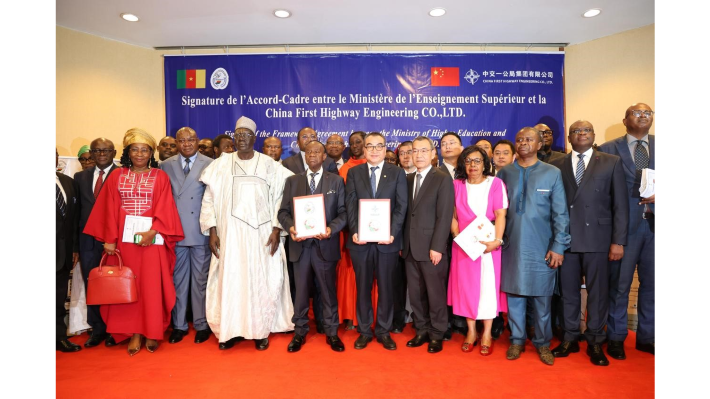
A colourful ceremony marking yet another milestone in burgeoning China-Cameroon cooperation was held on 13 January in Yaoundé. Witnessed by senior officials from both countries, Cameroon’s Ministry of Higher Education (MINESUP) and China First Highway Engineering Company (CFHEC) signed a framework agreement focused on skills development. Jacques Fame Ndongo, minister of state for higher education, and Zhao Zongzhi, director general of CFHEC, attended the event.
The main objective of the agreement is to strengthen the skills of young people in Cameroon. To this end, MINESUP and CFHEC have agreed to collaborate in training professionals who are ready to enter the workforce upon graduation and able to meet labour market needs.
This innovative approach goes beyond traditional academic training by offering practical education tailored to the country’s development priorities. MINESUP and CFHEC are committed to contributing proactively and responsibly to skills development and the training of the national workforce, which is essential for the implementation of large-scale infrastructure projects in Cameroon and the Central African sub-region.
Human capital
In line with their respective missions, MINESUP and CFHEC share the objective of developing the highly skilled human capital required to achieve the economic goals set out in Cameroon Vision 2035 and the National Development Strategy 2020-2030. The partnership, known as the MINESUP–CFHEC Professional Certification Programme, also aims to strengthen the professionalisation of university education and enhance graduate employability.
The programme will train and certify students in large-scale infrastructure construction, equipping them with additional skills recognised by a leading company in the sector under the supervision of MINESUP. This certification complements their academic qualifications and provides a valuable professional asset.
The partnership introduces a “double qualification” system, combining a university degree with CFHEC certification. Based on a 70/20/10 model of practice, mentoring and theory, it is designed to ensure that students are ready to begin work immediately after graduation.
In his speech, Ndongo encouraged students to go beyond theory: “It is no longer enough to have purely theoretical knowledge, which can already be found on the Internet and in books. All knowledge is grounded in practice. And our Chinese friends are already highly advanced in the expertise we are seeking today.”
According to Zhao, improving youth employability requires close coordination between higher education, industrial practice and professional skills development.
A major player
Based in Beijing, CFHEC is a subsidiary of China Communications Construction Company, specialising in transport infrastructure such as roads and railways. The company employs more than 25,000 people and has built over 18,000 km of roads worldwide, including motorway projects across Asia, Africa and the Middle East.
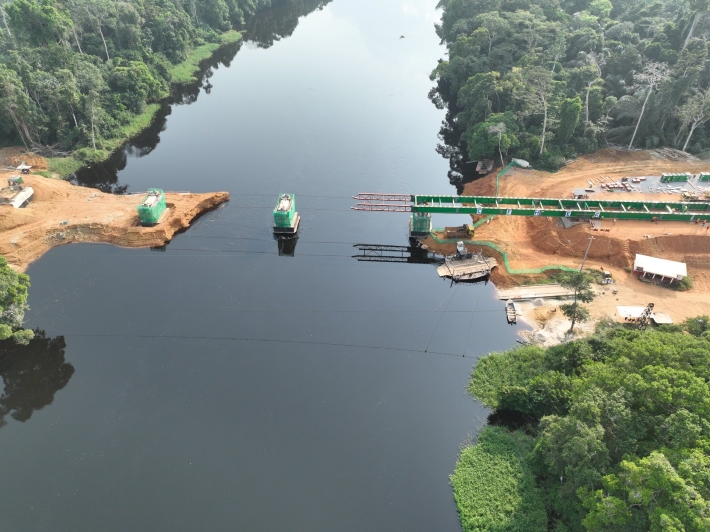
With a presence in Douala and Yaoundé, the country’s two largest cities, CFHEC has distinguished itself in Cameroon through several major projects. These include phases one and two of the Yaoundé-Douala motorway, built at a cost of approximately $444 million; the construction of the bridge over the Nyong River in Malombo; the development of the banks of the Wouri River in Douala; and the construction of the headquarters of the Directorate General of Taxes, costing approximately $35.8 million. Another project is under way, with CFHEC set to build 10 km of roads along the banks of the Wouri River at an estimated cost of $73.5 million.
These projects demonstrate CFHEC’s commitment to infrastructure development in Cameroon.
China and Cameroon are celebrating their 55th anniversary this year, marking an important milestone in cooperation between the two countries. China and Cameroon have maintained close ties based on mutual trust, win-win cooperation and respect for national sovereignty.
Over the years, cooperation has grown stronger, particularly in infrastructure, the economy and culture. More than half a century after the establishment of diplomatic relations, China has become Cameroon’s largest trading partner, with bilateral trade reaching $4.72 billion in 2024. Designated as the China-Africa Year of People-to-People Exchanges, 2026 presents a valuable opportunity to further strengthen ties between China and Africa, including Cameroon.
The two countries have reaffirmed their commitment to deepening cooperation, particularly in industrialisation, agriculture and health. China has also expressed its support for Cameroon’s economic and social development. In summary, China-Cameroon relations are flourishing, and both countries are determined to continue strengthening cooperation for the mutual benefit of their peoples.
