
Tracking a High-Tech Transition
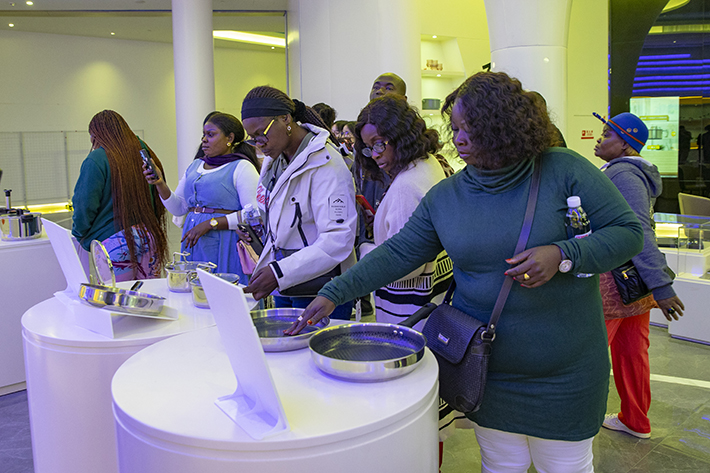
The moment a media delegation from the Republic of the Congo arrived at the Othello Kitchenware Museum on 18 November 2025, they were greeted with a vivid show of Guangdong’s industrial strength. Standing before them was not a typical exhibition hall, but a building shaped like a gleaming stainless-steel cooking pot.
Known as the world’s “largest soup pot building” and certified by Guinness World Records, the structure pairs futuristic metallic curves with the industrial heritage of its area. Its bold design not only serves as a striking local landmark, but also reinforces the image of Xinxing County as China’s home of stainless-steel kitchenware, giving the town an instant visual identity in a crowded manufacturing landscape.
Inside, displays of historical tools, VR experiences, and immersive theatre bring to life the evolution of Chinese kitchenware. For the visiting journalists, the museum was more than a creative photo stop; it offered a close-up look at the craft, technology, and brand development that have shaped China’s kitchenware industry, as well as the sector’s ongoing shift towards intelligent manufacturing.
Behind the museum stands the industrial strength of Xinxing County. Known nationwide as the heartland of stainless-steel kitchenware, the county in Yunfu City of Guangdong Province is home to more than 130 enterprises covering the full industrial chain. Its products ranging from stainless-steel and aluminium cookware to tableware, kettles, flasks and a range of household items are exported to nearly 200 countries and regions. In premium markets across Europe and the US, Xinxing’s stainless-steel kitchenware accounts for an impressive 45 percent of the supply.
From the founding of its first stainless-steel factory in 1986 to today’s global prominence, Xinxing’s success has rested on continuous innovation. In recent years, the county has strengthened its regional brand, upgraded production capacity, and encouraged industrial transformation. By embracing intelligent, digital and green development, the industry has enhanced its internal momentum and formed a robust manufacturing ecosystem with significant cluster advantages.
After touring the museum and several factories in the county, Le Prince Elidad Mode Elenga from Radio Congo shared his impressions. Not only had he learned the story of kitchenware’s evolution, but he had also gained a new appreciation for local innovation. “The diversity of production methods in Xinxing left a very strong impression on me,” he noted.
Xinxing is just one snapshot of how Guangdong, China’s largest provincial economy and a global manufacturing hub, is harnessing science and technology to fuel high-quality growth. At the forefront of Chinese modernisation, the province relies on technological innovation as the driving force behind its manufacturing upgrade.
Reinventing traditional industries
In Jinli Town, Zhaoqing, the delegation witnessed how technology is revolutionising even the most traditional products, like doors and windows.
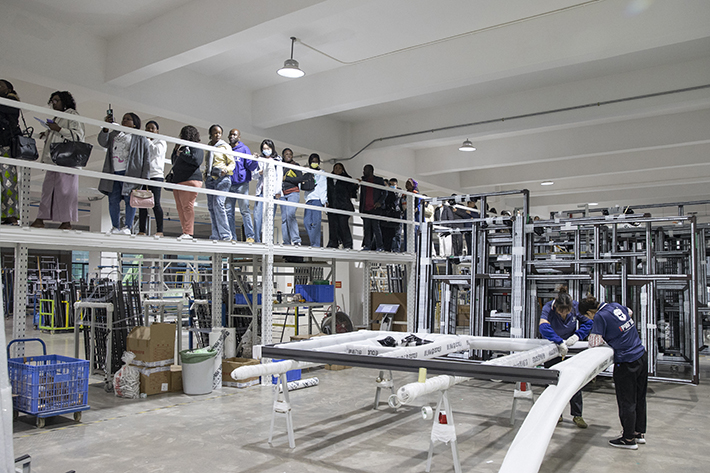
At the production facility of Edun, a leading manufacturer of doors and windows in China headquartered in Foshan City, a central intelligent control system functions as the “brain” of a fully integrated smart production chain. Industrial robots, automated sorting systems, chain-type storage and assembly lines work in tandem to create a highly efficient digital factory.
The facility, which began operations in March 2025, represents the highest level of automation in the domestic industry. According to General Manager Yuan Nanjing, robotic arms now perform most manufacturing tasks, leaving workers responsible mainly for packaging. The result is a dramatic improvement in both efficiency and safety.
The smart system also reduces reliance on experienced technicians and removes inconsistencies. “Previously, we needed skilled masters to identify materials. Now intelligent scanning does the work, cutting labour costs and improving accuracy,” Yuan told ChinAfrica.
Each production line has increased output by more than 30 percent while reducing labour costs. Coupled with Jinli Town’s well-established hardware supply chain, automation has also reduced delivery times for their largely customised products from 20 days to about one week. This efficiency enables the company to respond swiftly to online market trends, where viral products can emerge and disappear within weeks.
Powering emerging industries
At Guangdong Hongtu Technology’s Jinli branch, the delegation witnessed how innovation not only revitalises traditional die-casting technology, but also fuels the development of new industries, especially new energy vehicles (NEVs).
Hongtu is a key player in China’s automobile supply chain, known for a series of industry-leading breakthroughs. From its development of 2,000-tonne magnesium alloy die-casting machinery to the introduction of 3,500-tonne equipment, and later its joint creation of the world’s largest 12,000- and 16,000-tonne intelligent die-casting units, each milestone has pushed the boundaries of the sector.
According to its branch director Li Jianyong, the company’s integrated die-casting technology is vital to NEV development. By combining multiple components into a single casting, manufacturers can drastically reduce part counts and assembly steps. This significantly lowers vehicle weight, improving both range and handling - benefits that meet consumer expectations for efficiency and convenience.
On the production side, integrated die-casting shortens manufacturing cycles, boosts efficiency, reduces costs and enhances competitiveness.
The company has also developed its own series of advanced heat-treatment-free aluminium alloys, offering proprietary solutions tailored to the demands of large integrated components. “Materials that require no heat treatment reduce processing steps and lower costs,” Li told ChinAfrica.
With advanced digital manufacturing systems and lean production processes, Hongtu ensures stable, high-quality production while raising efficiency and reducing operating costs.
Technician Lionel Gahera Bakoulouka from Télé Congo was impressed by what he saw. “Both companies we visited have developed extremely well. I was especially struck by the speed of production at Edun and the orderly division of labour among workers,” he said, expressing hope for future cooperation between his country and Guangdong enterprises.
The power of technology
On the next leg of the trip, the delegation visited China’s leading NEV manufacturer XPENG’s industrial park in Zhaoqing High-tech Zone. Equipped with 389 ABB industrial robots, the facility forms a fully automated manufacturing ecosystem, achieving 100 percent automation for key assemblies. A new XPENG vehicle rolls off the line every 90 seconds. The company’s ambitions extend even into the skies, with plans to mass-produce its self-developed flying car in 2026.
Guangdong’s rapidly transforming factories left a strong impression on the visitors. They gained insight into the forces driving China’s rising international competitiveness. Whether upgrading traditional industries or accelerating emerging sectors, technology consistently proves to be the decisive factor.
For Chrislin Vivien Sita Nsemi, head of IT and community manager at Télé Congo, the lesson is clear: technology enhances productivity, improves work quality, reduces errors and creates new opportunities. “Zhaoqing’s experience shows that putting innovation at the heart of national strategy can transform an entire industry,” he said.
Across Guangdong, that transformation is unfolding everywhere. Smart factories hum with robotic precision, globalised industrial clusters pulse with activity, and companies of all sizes are embracing innovation as the engine driving high-quality growth.
From automated car assembly lines to advanced cookware emerging from intelligent factories, Guangdong’s industries illustrate how technology is reshaping manufacturing as we know it.
