
Tales of Connection Across Continents

On World Book Day, which falls on 23 April, readers around the globe are reminded of the simple joy of opening a book. Established by UNESCO, the annual observance encourages people to discover the pleasure and power of books. But for regions beyond immediate reach, including parts of Africa, reading can also serve as a first encounter, a journey to places one has never physically visited.
Three Chinese individuals have each forged deep personal and intellectual connections with Africa through their writing or travel. Diplomat and Arabic scholar Wu Fugui has brought Chinese readers closer to the world described by the 14th-century Moroccan traveller Ibn Battouta through his research. Writer Cai Xiao explores the lives of Chinese people working across Africa in his fiction. Travel enthusiast Wu Luanjin, now based in Côte d’Ivoire, retraces the landscapes once described by Albert Schweitzer, offering Chinese audiences on social media a more nuanced image of the continent through lived experience.
On the occasion of World Book Day, ChinAfrica invited the three to narrate how words and stories became their pathways to Africa.
Rediscovering Ibn Battouta
More than half a century ago, Wu Fugui first learned of Ibn Battouta’s Rihla, the travel account attributed to the renowned 14th-century Moroccan explorer. On 27 December 1963, during Premier Zhou Enlai’s first official visit to Rabat, Morocco’s King Hassan II presented an ancient book and recounted its history. The work recorded Ibn Battouta’s journeys across continents more than 600 years earlier.

According to the king, Ibn Battouta travelled extensively to China during the Yuan Dynasty (1271-1368), arriving at the port of Quanzhou and witnessing the richness of Confucian civilisation. After returning home, his dictated travelogue helped to introduce Chinese science and culture to the Western world.
“That story stayed with me deeply,” Wu recalled. “I began to wonder how this book itself had travelled in China. Who first introduced it to Chinese readers? How many scholars devoted their lives to studying and translating it?” It took Wu 10 years to find the answers.
In July 2025, he published his academic monograph Ibn Battouta’s Rihla in China. The book traces nearly a century of Chinese scholarship devoted to translating, interpreting and publishing the Arabic classic. Divided into five chapters, Wu’s book documents the work of three Chinese scholars, Zhang Xinglang, Ma Jinpeng and Li Guangbin, who, from 1924 to 2025, introduced Ibn Battouta to generations of Chinese readers.
In 1924, Zhang Xinglang, a professor at Fu Jen Catholic University, translated the sections describing China based on German and English editions, publishing them under the title The Moroccan Traveller Ibn Battouta and His Travelogue. It was the first time Chinese readers saw the explorer’s name in print. Over the following decades, scholars produced annotated editions, revised versions and eventually complete translations, forming a chain of academic work spanning generations.
Wu spent years collecting scattered historical materials, verifying archival sources and visiting the descendants of the three late scholars. He consulted diplomatic archives and invited senior Arabic studies scholars to contribute memoir essays narrating the history behind the research.
What Wu hoped to achieve was simple yet profound: to create a complete and authentic scholarly account of the book’s journey in China. As one Moroccan scholar remarked, “Chinese scholars have documented this history with even greater care than we have ourselves.”
Reflecting on this long academic continuum, Wu sees writing as a quiet yet lasting form of connection. From Ibn Battouta’s epic journeys to a century of Chinese translation and interpretation, and ultimately to the publication of his own work, the thread has never truly been broken. Through writing, two civilisations continue to move steadily closer to one another.
Recording people-to-people exchanges
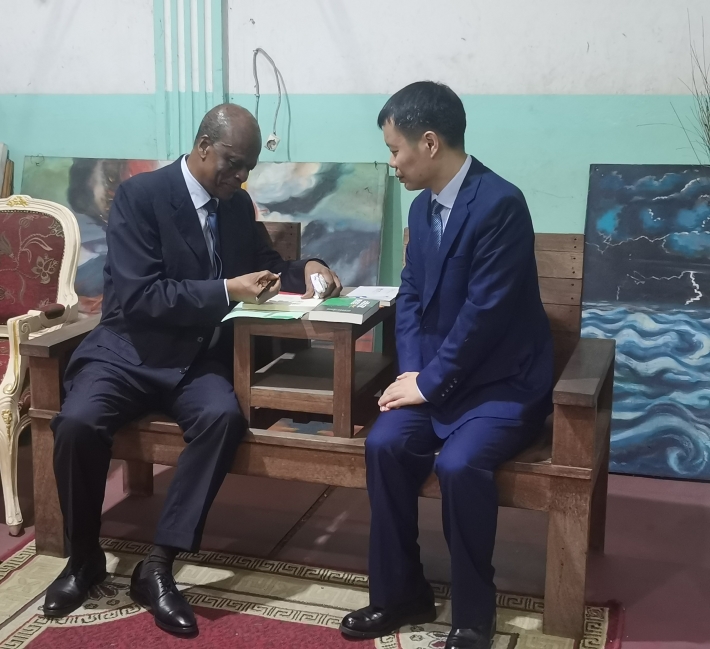
On Cai Xiao’s desk lies a book titled La traversée, a gift personally presented to him in the Republic of the Congo by Henri Djombo, former minister of agriculture, livestock and fisheries of the country and a writer. “The book recounts a turbulent period in Congolese history,” Cai said. “I sometimes feel it reflects Mr. Djombo’s own experiences.”
Now a member of the Beijing Writers Association, Cai published his novel Surging Zaire River in 2023. “I never imagined I would write fiction,” he told ChinAfrica. “I wasn’t a professional writer.”
After nearly two decades working in a national-level institution focused on international business, Cai encountered many Chinese living and working across Africa. He observed not only their contributions but also their personal struggles and emotional journeys.
“Today, there are about 2 million Chinese living and working in Africa,” he said. “Unlike decades ago, when most were involved in aid projects, they now work across a much broader range of fields.”
Yet Cai noticed that few people truly understood what these individuals experienced or how they felt. “History’s great waves are driven by countless small ripples,” he said. “If no one records them, those stories disappear.” Determined to capture those voices, he decided to travel to Africa himself and document them through his writing.
Preparing the novel required extensive research. Cai read academic studies, novels and media reports, watched Africa-related films, and conducted field visits across several countries. He spoke with diplomats, engineers, entrepreneurs, construction workers and local residents, visiting markets and mining sites while observing everyday life.
“I saw many Africans striving with the same determination Chinese people had during the early years of reform and opening up,” Cai recalled. “They were working hard to build better lives for themselves and their families. That energy deeply moved me.”
The result was Surging Zaire River. Named after the river now known as the Congo River, the novel is set in a fictional African country where diverse characters intersect: an embassy defence attaché, a retired special forces soldier, a telecommunications engineer, a rebel leader and African students returning home after studying abroad.
A book as a journey
Wu Luanjin is a young Chinese traveller with a deep passion for exploration who has visited numerous African countries in recent years. Some journeys were brief encounters, snapshots of Mauritius, Seychelles, Kenya, Ethiopia and Morocco. Others became longer chapters of work and life, particularly in Djibouti and Côte d’Ivoire, where she now resides.
Her connection with Africa, she said, began with a book, On the Edge of the Primeval Forest. The work chronicles the experiences of Albert Schweitzer, who practised medicine in Gabon between 1913 and 1917.
“The book’s descriptions of Central Africa’s nature, customs and diseases were striking,” Wu recalled. “What left the deepest impression on me, besides Schweitzer’s humanitarian spirit, were two words: poverty and illness.”
But those images belonged to more than a century ago. Many of the diseases described in the book have since disappeared. Yet Wu realised that for many Chinese readers, even after a hundred years, perceptions of Africa had remained frozen in the past.
“Africa has become the fastest-growing continent in the global economy,” she said. “In 2025, 12 of the world’s 20 fastest-growing economies were African countries.” Through social media, she continuously shares her observations, hoping to update public perceptions of the continent.

She remembers Djibouti as a place of perpetual summer, yet marked by the warmth of its people. Now living in Côte d’Ivoire, she describes a bustling urban life, heavy traffic, lively streets, confident and fashionable young women, and a strong sense of national pride among local residents.
Today, many Chinese citizens work and settle across Africa, with an increasing number of people travelling to destinations such as Kenya and Tanzania. Yet the continent still feels distant to many at home. Wu believes Africa represents both the future and an enduring friendship for China.
Everyone who sets foot in, or dreams of, Africa has their own “first book.” World Book Day reminds us that opening a book is a journey in itself. When words meet lived experience, that journey becomes a true arrival, a deeper encounter with Africa.
