
Seeds of Hope
On the northern shores of Lake Victoria in east Uganda lies the ancient Busoga Kingdom, a land whose roots stretch back to the 16th century. In the Soga language, “Busoga” translates to “land of the Soga people,” reflecting the deep connection between the land and its inhabitants. Once composed of seven counties and 11 chiefdoms, the kingdom is defined by the waters of Lake Kyoga and Lake Victoria, and the flow of the Nile River. It is home to roughly 4 million people, making up about one-tenth of Uganda’s total population.
Agriculture has long been the backbone of Busoga’s economy. Yet despite its fertile land and strong farming traditions, the kingdom continues to face deep socio-economic challenges. By 2024, about 65 percent of its youth were unemployed, and 1.16 million people lived below the poverty line, accounting for 14 percent of Uganda’s total impoverished population.
To tackle these challenges, Uganda’s Vice President Jessica Alupo launched the Village Agricultural Model (VAM) in 2023, a collaboration between China Agricultural University (CAU), the Vice President’s Office, and Busoga’s local government. Implemented by the Busoga Consortium for Development, the project aims to establish 12 demonstration villages across the region. Drawing on lessons from China’s rural revitalisation efforts, VAM seeks to help to lift communities out of poverty by 2030.
Among those driving this effort is Nathan Samuel Nkenga, minister of agriculture, animal industry and food technology in the Busoga Kingdom. With over four decades of experience in agricultural management, community development and farm extension, Nkenga has held roles as a supervisor for animal traction, cotton field officer, agricultural extension agent and development field officer. Fluent in English, Lusoga, and Luganda, he has spent his career closely connected to the soil and the farmers who depend on it.
When he looked at Jinja, political and cultural centre of Busoga Kingdom known for its mix of primary, secondary and tertiary industries, Nkenga saw more potential than challenge. “Our smallholders used to wait for aid,” he said. “But a better life doesn’t come by waiting. It comes from our own wisdom, hands and hard work.”
Cooperation with China
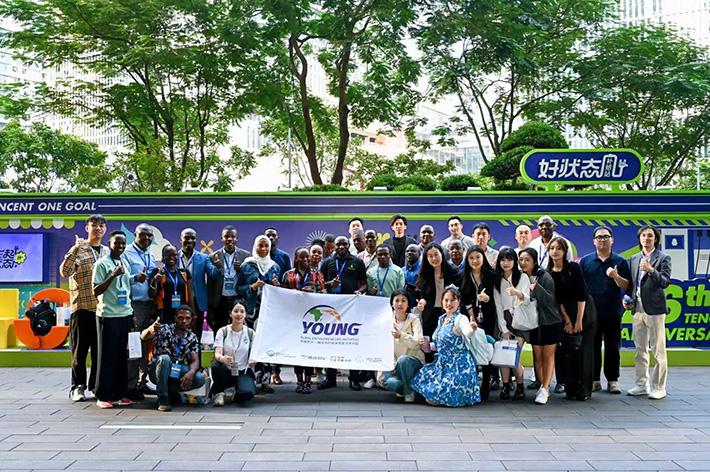
In November 2024, Nkenga joined the CAU-Tencent African Rural Entrepreneurs Initiative, a programme jointly launched by the CAU and Tencent, China’s leading Internet and digital technology company. Under the programme, African leaders and youth are invited to study China’s rural transformation firsthand. Nkenga’s visit took him from Shenzhen, where he learned about digital agriculture and e-commerce, to Xishuangbanna, where he witnessed poverty reduction through ethnic tourism initiatives like the “Yao Mother’s Hostel” and finally to Beijing’s Pinggu National Agricultural Science and Technology Park, where he saw how smart farming technologies are reshaping rural life.
What stood out to him the most was the cooperative model that enabled villagers in China to move beyond mere subsistence. Supported by universities and local governments, farmers pooled funds and resources to form cooperatives, connecting smallholders to markets and promoting collective ownership, an approach Nkenga believes could be adopted in Busoga.
“I found the formula for my country,” Nkenga told his mentor Li Li, an associate professor at CAU. “If villagers can form cooperatives and invest together, they can be engaged in production and move from poverty to prosperity.”

Turning vision into action
Upon returning to Uganda, Nkenga wasted no time. In Bubwika Village, he organised three community meetings to unite local households around a shared vision of cooperation. Within six months, six production groups were established, including three for women, two for youth and one mixed, bringing together 120 farming households into a single agricultural cooperative.
The cooperative’s structure closely mirrored the “three-industry integration” model that Nkenga had studied in China. In the primary industry, the focus was on cultivating a variety of crops, including maize, rice, peanuts, coffee, sugarcane, potatoes, cassava, and soybeans, alongside raising livestock such as cattle, goats, pigs, and poultry. The secondary industry focused on food packaging and processing, turning raw agricultural products into marketable goods that added value and created much-needed employment opportunities for local residents. Lastly, the tertiary sector sought to utilise Busoga’s scenic beauty by developing rural tourism. The goal is to promote the region’s natural wonders in order to attract visitors and diversify household incomes beyond agriculture.
He also introduced equity incentives and cooperative ownership structures aimed at engaging women and youth, drawing inspiration from China’s Household Contract Responsibility System.
From obstacles to opportunities
While progress was swift in crop production, poultry farming presented new challenges. Bubwika’s smallholders lacked the expertise and facilities for intensive poultry rearing. To address this, Nkenga began liaising with Beijing Huadu Yukou Poultry Industry Co., Ltd., hoping to replicate its large-scale and efficient production practices.
“The women in Bubwika are eager to learn scientific poultry farming from China,” Nkenga said with a smile. “Our livestock industry is almost ready for scaled production; we just need the right knowledge and discipline.”
Despite limited resources, his project is already showing promising results. Farmers who once relied on aid are now pooling savings, sharing risks, and planning for expansion. “Step by step, day by day, our ancient kingdom will thrive again - not through aid, but through our own hard work,” Nkenga said.
