
Paving Pathways to Progress
From lecture halls in Beijing to villages in the mountains of southwest China, a group of young rural innovators from Global South countries recently embarked on a journey that connected policy thinking, technological practice and lived rural experience.
Between 30 November and 9 December 2025, 49 participants and national coordinators from Indonesia, Kenya, Laos, Tanzania and Uganda gathered in China for the opening phase of the CAU–Tencent Global South Young Rural Entrepreneurs Initiative, jointly launched by China Agricultural University (CAU) and Chinese tech giant Tencent.
Through classroom learning, field observation and hands-on practice, the programme offered participants a multidimensional view of China’s agricultural modernisation and rural transformation. More importantly, it created a platform for South-South learning, encouraging young leaders to reflect on how China’s experience could be translated into solutions tailored to their respective countries’ realities.
China’s rural transformation
The programme opened in Beijing with a structured learning phase built around a training framework integrating concepts, knowledge and skills. At the opening ceremony, Du Taisheng, vice president of CAU, underscored the programme’s long-term vision. “Through systematic training, we hope to share China’s experience in rural revitalisation and poverty reduction with young people from different countries, and support them in combining these lessons with their own national contexts,” he noted.
Academic sessions introduced participants to China’s development trajectory and rural transformation strategy. Li Xiaoyun, lead chair professor at CAU, said Global South countries are not obliged to follow the lengthy, linear development paths of industrialised nations. Drawing on China’s experience, he explained how “compressed development” has allowed infrastructure construction, industrial upgrading and social development to advance simultaneously, offering pathways for countries facing similar transformation pressures.
For many participants, the coherence of China’s policy approach stood out. “The courses helped me to better understand the long-term thinking and policy continuity behind China’s development,” said Lukman Hakim, a lecturer from Indonesia. “The emphasis on infrastructure first and technology-enabled agriculture provides a useful macro framework for understanding rural transformation in our own country.”
Skills training translated theory into practice. Courses on agricultural e-commerce, digital branding and livestreaming sales demonstrated how digital tools connect farms directly with consumers. “China’s model of government guidance, market participation and farmer-centred implementation is particularly inspiring,” said Ilham Indanu Sitepu, founder of an ecological farm in Indonesia. “It gives us concrete ideas for improving both farm operations and community cooperation back home.”
Digital tools for inclusive growth
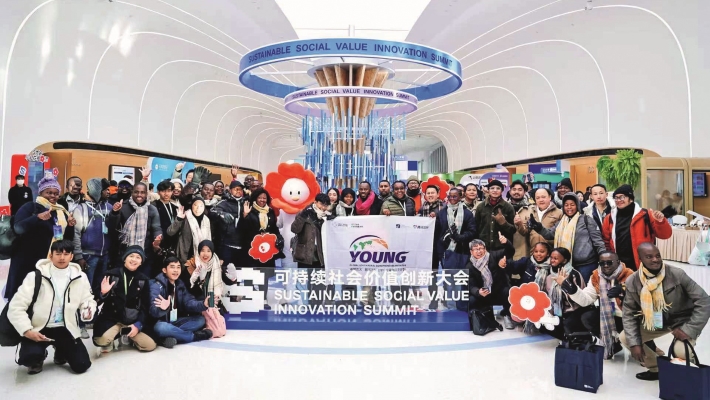
A visit to Tencent helped participants to understand how digital technology can serve inclusive and sustainable rural development. At the 2025 Sustainable Social Value Innovation Summit, held in Beijing on 3 December 2025, participants explored real-world applications of artificial intelligence, moving beyond abstract discussions.
Kenyan aquaculture entrepreneur Vincent Oduor described the experience as eye-opening. “In the past, AI often felt like a distant concept,” he told ChinAfrica. “Here, I saw practical solutions that could truly transform rural industries.”
The WeVillage demonstration area attracted particular attention. Showcasing speciality agricultural products developed by rural entrepreneurs across China, it demonstrated how digital branding and e-commerce can unlock value from local resources. Indonesian coffee entrepreneur Irvan Didi Pramana was especially impressed. “Livestream e-commerce allows products from remote villages to reach national consumers directly. This is a model we can adapt in Indonesia,” he said.
Tencent representatives stressed that technology alone is not the answer. “Digital tools are not meant to replace people, but to empower them,” said Cheng Zenan, senior project manager at Tencent’s Sustainable Social Value division. This perspective resonated strongly with participants.
.jpg)
Village-level innovation
The programme concluded in Yunnan Province, where participants witnessed how rural revitalisation unfolds at the village level. In Hebian Village, once a remote border settlement, diversified livelihoods have transformed local life. Rubber tapping, winter vegetable farming and rural tourism are carefully arranged across the year, creating what village leaders described as a “time-based income system.”
“How can villagers manage so many activities at once?” asked Tanzanian livestock officer Abdallah Waziri Mahimbo during a field discussion. Village CEO Pan Yongfei explained that seasonal scheduling allows households to maintain traditional livelihoods while developing new income sources.
The participants also visited facilities that showcased integrated agroforestry, coffee-tourism integration and drone-based farming services.
As the journey ended, participants reflected on shared themes that defined their experience: people-centred development, appropriate technology and youth leadership. “China did not simply copy Western models,” said Kenyan agricultural officer Alice Mumbi Thome. “It created its own path. That is the most inspiring lesson for us.”
More than a study tour, the initiative fostered a growing South–South network of young rural changemakers. Supported by year-long mentorship, they now return home prepared to adapt China’s experience into locally grounded pathways.
