
Making a Difference
The Thursday flight from China to Zimbabwe’s capital Harare has become a permanent, welcome feature. While there are a handful of returning locals and international aid workers, the overwhelming majority are Chinese citizens.
But they are not tourists. They are mid-level executives, seasoned project managers with leather folios stuffed with feasibility reports, and younger, sharply dressed tech entrepreneurs.
“We receive hundreds of potential Chinese investors every week who are ready to explore an array of investment opportunities in the country,” Amon Murwira, Zimbabwe’s minister of foreign affairs and international trade, told ChinAfrica.
According to Zimbabwe’s The Herald newspaper, around 500 Chinese investors registered in the country in 2025, pledging investments of about $2.5 billion - over one-third of which is in manufacturing. The newspaper said most of these investments are focused on the mining and manufacturing sectors, highlighting the country’s growing appeal as a prime investment destination.
Long-term investment
Chinese Ambassador to Zimbabwe Zhou Ding said the Zimbabwe-China relationship, soon to enter its 46th anniversary, has created fertile ground for mutually beneficial partnerships.
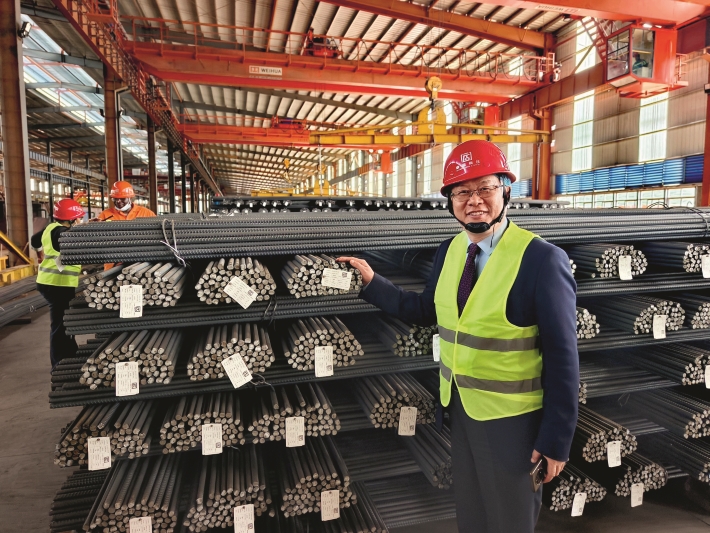
Zhou made the remarks during a tour of one of these partnerships - Dinson Iron and Steel Co. (DISCO) in Mvuma - at the end of January. He noted that this was an example of how Zimbabwe-China cooperation was delivering tangible economic benefits through value addition, job creation and export growth.
DISCO is the largest steel company in Southern Africa and has already helped to lower steel prices in the Southern African Development Community region. At its peak, it will have an annual steel output of approximately 600,000 tonnes - 60 percent of which will be exported. It will also create thousands of jobs and generate essential foreign exchange for the country.
“During President Emmerson Mnangagwa’s successful visit to China last year, our two heads of state elevated bilateral relations to an all-weather community with a shared future. This historic commitment has injected powerful momentum into our cooperation,” Zhou told The Herald.
“This is a clear vote of confidence in Zimbabwe’s vision of being open for business,” Zhou added.
He emphasised that Harare has made significant progress in its infrastructure development journey with the establishment of DISCO, a key player in the country’s industrialisation efforts.
“Well, they say iron and steel are the food or backbone of industry; Zimbabwe’s iron and steel industry has enough food following the setting up of DISCO. Zimbabwe is slowly having food for socio-economic growth through the production of steel products,” Zhou said, reiterating China’s commitment to supporting Zimbabwe’s development.
“What impresses me most is that they are not only manufacturing products, but also addressing local community needs through corporate social responsibility programmes. They are building roads, drilling boreholes, and renovating schools, demonstrating the tangible benefits of China-Zimbabwe cooperation.”
Downstream benefits crucial
Speaking on the sidelines of the 2026 Chinese New Year Carnival in Harare in February, Monica Mutsvangwa, Zimbabwe’s minister of women’s affairs, community, small and medium enterprises development, said the upgraded bilateral relationship is now yielding tangible economic dividends for the nation’s local industries.
Mutsvangwa highlighted that small and medium enterprises are the current “pulse” of the Zimbabwean economy, contributing over 60 percent of the national GDP.
She stressed that the government is prioritising the acquisition of digital skills and technology transfer from Chinese counterparts to ensure that local companies can compete on an international scale.
Reflecting on recent high-level engagements, Mutsvangwa pointed to the successful visit of a recent delegation of 53 Zimbabwean small and medium enterprises to China.
She explained that these visits are designed to provide local business owners with a first-hand look at how Chinese corporations, many of which started as small enterprises, successfully scaled into global giants.
Mutsvangwa expressed her desire to see more “downstream benefits” from major Chinese investments in Zimbabwe, specifically citing DISCO and various mining ventures as critical engines for local employment and industrial value addition.
Chinese private capital is playing a pivotal role in financing Zimbabwe’s critical infrastructure, she said, including cement production and power generation, which are essential for achieving the goals of Vision 2030.
Energy sector boost
Across the country, from energy generation to digital connectivity, Chinese capital and expertise are being deployed in a coordinated push to help to achieve Vision 2030.
At a recent seminar hosted by the Chinese Embassy in Zimbabwe and the Southern African Research and Documentation Centre, Zhou linked China’s latest Five-year Plan with Zimbabwe’s National Development Strategy and Vision 2030.
He emphasised China’s readiness to align its strategic blueprints with Zimbabwe’s, deepening practical cooperation in trade, infrastructure, and energy to support the country’s quest for upper-middle-income status.
The energy sector has been a primary recipient of this focus, addressing a critical bottleneck to Zimbabwe’s industrial ambitions.
For years, businesses and households endured crippling power cuts that stifled production and investment. Chinese financing and construction have fundamentally altered that landscape.
The expansion of Zimbabwe’s Kariba South Power Station added hundreds of megawatts to the grid, while the completion of new units at the Hwange Thermal Power Station contributed a further significant increase in generating capacity.
Beyond the macro-grid, China is also investing in the micro foundations of the economy in water and soil. In a recent initiative, Zhou attended the launch of a new China-FAO South-South cooperation project.
These initiatives, focused on sustainable soil management and developing a national water roadmap towards 2030, are designed to modernise agriculture and bolster food security. The work aligns with Zimbabwe’s Rural Development Initiative, aiming to transform subsistence farming into productive agribusiness.
