
Flowing Into a Better Life
In Bom Jesus Municipality, a cool breeze drifts in from the Kwanza River, softening the edges of a town marked by landmarks such as António Agostinho Neto International Airport. Yet beneath Luanda’s scenic façade, daily life for many residents is defined by a persistent struggle for water.
“We have to walk 5 to 15 km to access water. This perennial problem is so depressing. What’s more, the lack of clean water causes waterborne diseases in our community,” local resident Isabel Fernando told ChinAfrica.
Helena Luciano shares the same reality. Like thousands of others, she makes long, exhausting journeys in search of water, often balancing heavy jerrycans on her head or shoulders.
“The water we collect is usually murky and has to be boiled to make it safe,” Luciano said. “That consumes valuable firewood and time. We really need better infrastructure and climate-resilient measures to improve access to water in our area.”
Fernando noted that inadequate infrastructure, compounded by a variable climate, has long been the cause of water scarcity in Luanda. Despite being surrounded by water, she said, only about half of the city’s population has access to clean running water, forcing many households to rely on expensive and unreliable informal suppliers.
“I can’t wait for the day when this nightmare of walking kilometres for drinking water ends,” she said. “I dream of a life where the worry of water is finally washed away.”
A major water project being carried out by the Power Construction Corp. of China, or PowerChina, could soon help to bring this long-standing struggle to an end.
Channel of hope
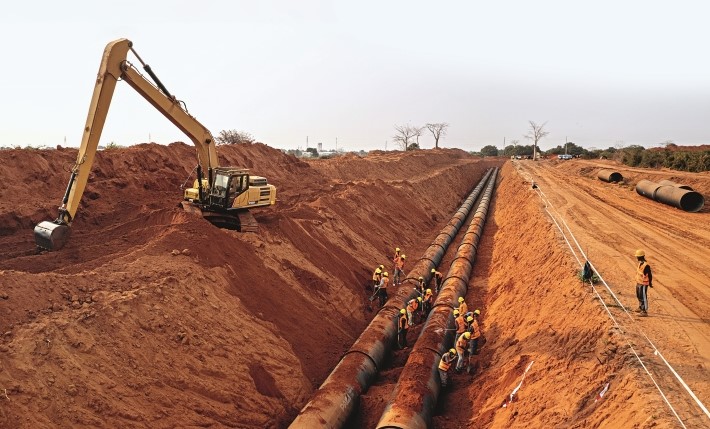
Across the rolling hills of Bom Jesus, wide, freshly excavated trenches cut through the landscape, forming channels that will soon deliver clean water under the Quilonga Grande Water Supply Project, known as System 5. As Angola’s largest ongoing water supply initiative, the project has become a concrete symbol of hope for surrounding communities.
At the construction site in east Luanda, workers carry out their duties with precision and coordination, underscoring the organised approach to the project’s implementation by PowerChina.
“We have laid a solid foundation for the main structure and construction is underway as planned. Once completed, the project will significantly ease the chronic water shortages in east Luanda,” PowerChina chief engineer Zhang Peng recently affirmed.
Zhang Qiang, PowerChina’s project manager, introduced the key components of the Quilonga Water Supply Project: a raw water pumping station with a daily capacity of 570,000 cubic metres, a 12.5 km raw water pipeline, and a water treatment plant capable of processing 500,000 cubic metres daily.
Water experts say once completed, the System 5 project will provide clean drinking water to the province of Icolo e Bengo and the northeastern areas of Luanda, securing water supply for 5 million people and addressing the challenges posed by rapid population growth and inadequate existing infrastructure.
“The facility will connect 11 distribution centres with a total storage capacity of 283,600 cubic metres,” Zhang added.
According to experts, the city of Luanda, with a population of 10 million residents, has a shortage of 1.2 million cubic metres of water per day, primarily caused by three outdated supply systems.
João Baptista Borges, Angola’s minister of energy and water, recently said the project, which will increase daily water supply capacity by 510,000 cubic metres, aims to connect 350,000 more households to the water network.
“It plays a crucial role in enhancing urban water security, improving residents’ quality of life, and fostering sustainable social development,” Borges said during a concrete pouring ceremony for the water intake pump station held by PowerChina.
He added that the integrated project covers water intake, transmission, treatment, and sludge treatment, benefitting around 5 million residents.
Besides improving water supply, the project will help to bridge socioeconomic gaps, according to the government.
“The project will provide around 300 direct jobs, and over 90 skilled workers will be trained in various areas, including cultural exchange, language training, and the hiring of local engineers with study experience in China, which helps to foster mutual understanding and cooperation among staff.”
Local development
Bom Jesus Municipality Administrator Helmano Adriano praised PowerChina’s commitment to local communities through public welfare projects, such as building drinking water systems, installing power grids, and supporting community initiatives, which directly benefit thousands of residents.
The national water supplier Empresa Pública de Águas EPAL-EP has stated that the system is designed to meet increasing water demand in Luanda and strengthen the area’s water capacity by sourcing water from the Kwanza River, approximately 50 km from the capital.
The water utility firm revealed that the project comprises raw water pumping stations, transmission pipelines, and distribution centres designed to enhance the efficient delivery of clean water, thereby significantly improving water quality in the region.
EPAL-EP Administrator Kelson Domingos highlighted that Luanda Province is undergoing rapid population growth, making access to clean drinking water a critical issue for Angola’s residents.
“In response, Angolan authorities have launched an extensive programme aimed at improving water supply infrastructure. This initiative includes the construction of two water plants, Bita and Quilonga Grande, along with expanded distribution networks,” he noted.
In this context, Chinese Ambassador to Angola Zhang Bin recently announced new strategic projects for Angola, including the Caculo-Cabaça hydropower project and the new Caio Deep Water Port in Cabinda Province.
Zhang said the major projects currently underway reflect strengthened relations between China and Angola.
“There are many Chinese companies with a great interest in investing in Angola, and the embassy would help to make these investments a reality,” Zhang said.
