
Collaborative Approaches to Poverty Reduction
The 17 Sustainable Development Goals (SDGs) for 2030, adopted by all United Nations member states in 2015, are facing a range of challenges. Factors such as climate change, regional conflicts and economic recession are having a significant impact, particularly on global poverty governance.
As a platform for dialogue, exchange and technical cooperation, the 2025 International Seminar on Global Poverty Reduction Partnerships was held in Beijing on 10 December 2025.
Themed “Strengthening Partnerships to Address Poverty Reduction Challenges”, the seminar brought together nearly 200 officials and guests from 17 countries and seven international organisations to discuss new pathways for promoting the sustainable development of global poverty reduction and food security.
Co-hosted by the International Poverty Reduction Centre in China, the Food and Agriculture Organization of the United Nations (FAO), the International Fund for Agricultural Development, the World Food Programme (WFP) and the China Internet Information Centre, the case-sharing session highlighted a number of positive initiatives currently under way.
Representatives from the Ministry of Agriculture and Rural Affairs (MARA), the Ministry of Commerce, the WFP, Guangdong Province and the Guangxi Zhuang Autonomous Region shared cooperative projects, showcasing innovative practices and successful experiences in poverty reduction.
Education and employment assistance
Yantian District, located in the eastern part of Shenzhen in south China’s Guangdong Province, is a coastal urban area known for its scenic environment and innovative industries. Benefitting from the dividends of China’s reform and opening up policy over the past 47 years, Yantian has written a new chapter in innovative cooperation.
Since establishing a partnership with Leye County in Baise City, Guangxi Zhuang Autonomous Region, in 2016, Yantian has explored a unique assistance pathway through collaboration among governments, schools and enterprises. This approach has built a bridge for young people in southwest China to change their life prospects.
Li Zhong, secretary of the CPC Yantian District Committee, said the partnership helped Leye to eradicate poverty in 2020 through cooperation in five areas: industry, employment, education, health care and ecology. Throughout the process, Yantian prioritised education assistance. While young people in Leye faced difficulties in vocational education and employment, enterprises in Yantian were in urgent need of highly skilled specialists.
In 2021, the governments of the two regions launched a joint programme, creating a closed-loop model in which schools design courses based on enterprises’ needs, while enterprises provide internship placements and subsequent job opportunities for students who pass assessments.
This model addressed two challenges simultaneously. Over the past four years, it has helped 669 young people enrol in schools, 524 of whom have worked in Yantian District after graduation. Some students chose to pursue further education or enlist in the military, broadening their career options. Meanwhile, enterprises saved an average of 700,000 to 1 million yuan ($100,000-$140,000) annually in recruitment costs.
South-South agricultural cooperation
Over the past four decades since its establishment, the Foreign Economic Cooperation Centre of MARA has engaged in South-South agricultural co-operation through investment and trade, regional collaboration and policy research, helping developing countries to enhance their agricultural production capacity.
Jin Ke, director-general of the centre, shared two successful cases. Under the FAO South-South Cooperation Framework, the centre implemented its first project with the Namibian government from 2015 to 2018, achieving notable results. The project dispatched 150 Chinese agricultural experts, introduced 15 rice varieties and promoted techniques such as seedling cultivation and mechanised transplanting.
As a result, local sowing and transplanting cycles were shortened from nearly five months to about two months, while the cumulative planting area expanded to over 6,000 hectares, significantly reducing labour costs.
Beyond technology transfer, the project organised more than 20 training sessions for over 500 local participants, cultivating a group of agricultural technical professionals. Chinese experts also optimised the local rice grading process, helping farmers to expand sales channels and increase income. The achievements were highly recognised by both the FAO and the Namibian government. The second phase of the project was launched in September 2023.
In 2024, the centre, Shanghai Ocean University and Cambodia’s Ministry of Agriculture, Forestry and Fisheries jointly launched a smart aquaculture pilot project under the China-ASEAN Smart Farm Integrated Development Pilot Programme. The project focuses on the digitalised cultivation of giant river prawn larvae, and has established three smart farming demonstration sites in Cambodia’s Takeo Province, covering 36.6 hectares.
The project has also trained more than 200 farmers and technical officials, with farmers’ annual household income per hectare increasing threefold. This has injected sustainable momentum into the local freshwater aquaculture industry.
“Since 2004, we have organised over 200 training programmes in areas including poverty reduction, food security, agricultural technology innovation and climate change,” Jin said.
Empowering African farmers
Africa continues to face serious food security challenges. According to the latest analysis released by the WFP in May 2025, more than 36 million people in West and Central Africa struggle to meet their basic food and nutrition needs.
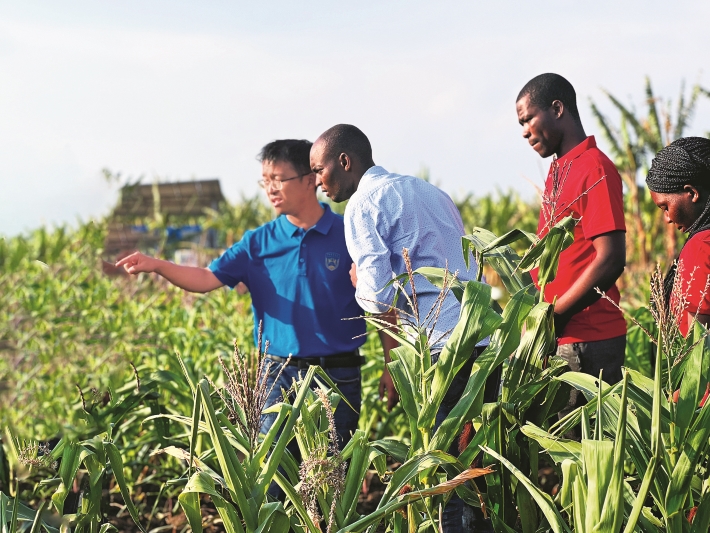
Feng Yan, programme officer at the China Centre of Excellence for Rural Development of the WFP, shared how her centre has helped to enhance smallholder productivity in West Africa. At project sites in Côte d’Ivoire and Guinea, low rice productivity and high post-harvest losses are major factors limiting farmers’ incomes.
Sponsored by the Gates Foundation and implemented in collaboration with the WFP and local rural development centres, the project provided two kilograms of rice seeds, 16,000 kilograms of fertiliser and small agricultural machinery from China. In Côte d’Ivoire, rice yields per hectare increased from nearly one tonne to about three tonnes, while Guinea achieved an annual yield growth rate of 2 to 3 percent.
The project organised three study tours in China, enabling local officials and farmer representatives to learn about technology and equipment operation.
Feng noted that the introduction of Chinese equipment and rice varieties tailored to local needs was a key factor in improving grain production capacity. “We connected international organisations with China’s technological expertise and worked closely with African countries, regional governments and local communities, in line with the core principles of South-South cooperation,” she said.
