
Building Resilience Through Cooperation
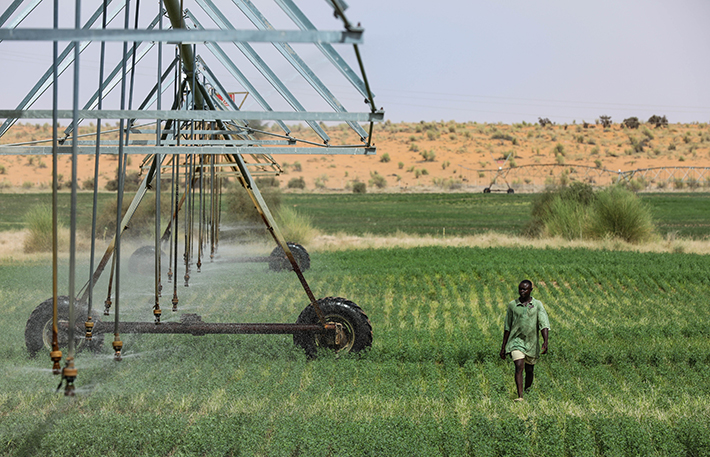
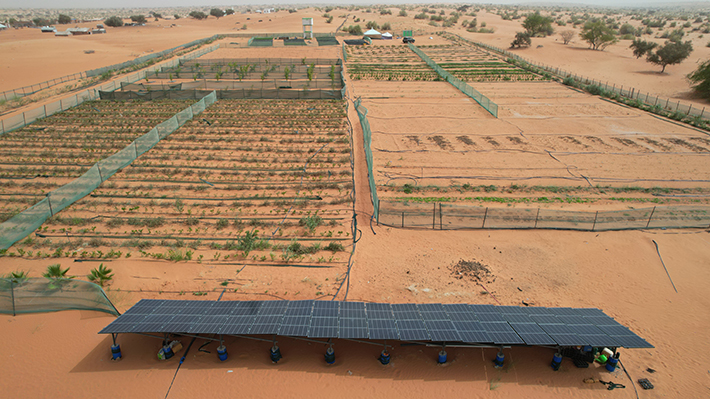
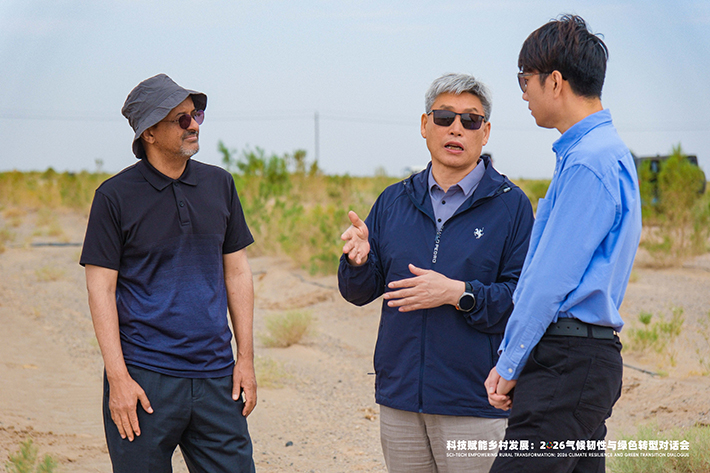
Jinta County in Gansu Province, located between the Badain Jaran and Kumtag deserts, hosted an international gathering on 5 June on the occasion of World Environment Day, dedicated to climate resilience and ecological transition. On this occasion, Mohamed Abdellahi El Vilaly, Mauritania’s ambassador to China, spoke to ChinAfrica about the outcomes of China-Mauritania cooperation in combating desertification, and shared his views on the prospects for economic and trade cooperation, as well as the strengthening of people-to-people and cultural exchanges between the two countries.
ChinAfrica: Drought and desertification have a profound impact on Mauritania’s development and the daily lives of its people. What cooperation mechanisms has Mauritania established with China to address these challenges?
Mohamed Abdellahi El Vilaly: Our country is often called “the land of the veiled people,” referring to the litham, the traditional veil worn for protection against wind, sand, heat and particularly the harsh climatic conditions of the desert. One could say, therefore, that the desert is deeply rooted in our way of life. Today, it covers approximately two-thirds of the national territory.
At the same time, drought and desertification have long been major challenges for our country. For more than half a century, Mauritania has worked to confront drought and has gradually developed adaptation mechanisms and considerable experience in this field.
Since the establishment of diplomatic relations between our two countries in 1965, cooperation has continued to strengthen across numerous sectors. In recent years, exchanges in the field of combating desertification have intensified in particular.
We have developed fruitful cooperation with Ningxia Hui Autonomous Region in the field of fodder cultivation. Through this cooperation, we have established a fodder production system capable of coping with drought and soil salinisation. This project is of great importance for Mauritania.
We also maintain close relations with the Xinjiang Institute of Ecology and Geography, Chinese Academy of Sciences. Together, we are working on several projects related to combating desertification.
Mauritania also participates in the Great Green Wall for Africa, a vast environmental initiative that traverses the continent from west to east. In this context, we have learned much from Chinese experience, particularly that of Xinjiang. Pilot projects are currently being implemented in Mauritania to introduce innovative Chinese technologies, notably in subterranean irrigation and dune fixation. These technologies are of considerable interest and could also benefit other countries facing similar challenges.
Gansu Province also possesses recognised expertise in combating desertification. Last year, a delegation from Gansu Provincial People’s Congress visited Mauritania to explore new avenues of cooperation in this field. During my visit to Gansu, I am continuing exchanges with local authorities in order to further deepen this cooperation.
How do you evaluate the role played by China in combating desertification and promoting green development?
In the face of climate change, no country can act alone. This is a global challenge that requires a collective response. We greatly appreciate the role China has played in promoting green development. Its advances in clean energy have made technologies more accessible and affordable for many developing countries.
China also contributes significantly through technology sharing, knowledge transfer and expert exchanges. In addition, the Green Belt and Road Initiative provides an important framework for promoting environmental cooperation and sustainable development.
For Mauritania, needs extend beyond technology transfer. Human resource training, technical capacity-building and experience exchange are equally essential. Through this cooperation, we can not only better combat drought and desertification, but also create more employment and improve living conditions for rural populations. That is why we wish to continue deepening our partnership with China in this strategic field.
Our cooperation is not limited to ecological areas. Regarding the economy, with the opportunities offered by the zero-tariff treatment policy, what new potential for cooperation do you see emerging between China and Mauritania?
For several consecutive years, China has been Mauritania’s leading trading partner. Exchanges between our two countries are particularly dynamic. Mauritania exports mainly iron ore, fishery products and other resources including gold to China, while it imports a wide range of Chinese products.
Our country is among the 33 least developed countries benefitting from the zero-tariff treatment granted by China since 2024. Products manufactured in Mauritania enjoy privileged access to the Chinese market through customs duty exemption. This measure should both stimulate Chinese investment and enable Mauritania to better develop its natural resources.
In this context, we hope the zero-tariff treatment policy will encourage more Chinese companies to invest in Mauritania, notably in the industrial sector, in order to create more jobs.
The year 2026 marks the China-Africa Year of People-to-People Exchanges. What importance does this thematic year hold, in your view, for the deepening of China-Mauritania relations?
People-to-people and cultural exchanges between our two countries are already very active. Numerous Mauritanians travel to China to study, while many Chinese investors and entrepreneurs work or reside in Mauritania.
Mauritania has attached great importance to learning Chinese for several decades. The language has long been part of the curriculum at the University of Nouakchott. In 2019, a Confucius Institute was established at the university in cooperation with Hebei University.
Mauritanians show strong interest in learning Chinese. Many come to China to study the language and pursue university studies, particularly in scientific and technical disciplines. Chinese universities today offer high-quality training in fields such as mining, artificial intelligence and other cutting-edge sectors.
We hope to further deepen cooperation in the years ahead, particularly in technical and vocational training, which is essential for meeting labour market needs. Exchanges are already under way with Chinese partners in this regard. We are convinced that strengthening educational, scientific and cultural exchanges will contribute to bringing the Chinese and Mauritanian peoples closer and opening new perspectives for cooperation between our two countries.
