
Building Bonds, Advancing Development
By Ni Xiaowei and Ma Hanzhi
The year 2026 marks the 70th anniversary of the establishment of diplomatic relations between China and African countries. It also marks the launch of the China-Africa Year of People-to-People Exchanges.
At this pivotal juncture linking past achievements with future development, Wang Yi, member of the Political Bureau of the Communist Party of China Central Committee and foreign minister, continued the longstanding diplomatic tradition under which the Chinese foreign minister makes Africa the destination of the first overseas visit of the year, a practice upheld for 36 consecutive years, underscoring the stability, continuity and sincerity of China’s policy towards Africa.
From 7 to 12 January, Wang paid official visits to Ethiopia, Tanzania and Lesotho, and attended the opening ceremony of the China-Africa Year of People-to-People Exchanges at the headquarters of the African Union (AU). Due to scheduling adjustments, the originally planned visit to Somalia was postponed. However, while in Africa, he held a telephone conversation with Somali Foreign Minister Abdisalam Abdi Ali, effectively compensating for the inability to visit in person. This special arrangement reflected the close bonds and mutual support underpinning China-Africa friendship, and underscored the deep and enduring ties between China and Somalia.
During the visit, Wang reached broad consensus with African partners and achieved tangible outcomes in strengthening mutual support, expanding practical cooperation and advancing people-to-people exchanges, which injected strong momentum into the building of an all-weather China-Africa community with a shared future in the new era.
Reliable partners
Against the backdrop of growing global turbulence, the Chinese foreign minister’s first overseas visit of the year to Africa sent a strong and unmistakable signal of China-Africa solidarity and steadfast mutual support. During the visit, African leaders reaffirmed their commitment to the one-China principle, expressed firm support for China in safeguarding its core interests, and spoke highly of the four global initiatives on governance, security, development and civilisation proposed by President Xi Jinping. They also conveyed their readiness to further strengthen strategic mutual trust with China and enhance coordination and support in regional and international affairs.
Notably, the AU responded promptly and positively to President Xi’s Global Governance Initiative, expressing its willingness to work with China to advance the implementation of the four global initiatives. Such support is particularly significant, underscoring both the contemporary relevance and the strategic depth of China-Africa mutual support. In an interview with Chinese media following the conclusion of his visit, Wang said many African friends had candidly noted that upholding the one-China principle is, in essence, an act that benefits Africa itself. This profound recognition reflects a qualitative elevation of China-Africa mutual support and highlights the distinctive character and enduring vitality of China-Africa friendship.
Over the past year, the US has sharply reduced its assistance to Africa. Coupled with trade protectionist measures and intensified diplomatic pressure, these developments have further complicated the external environment confronting many African countries. Lesotho’s textile industry has been particularly affected by a shift in US policy, which has forced the country to declare a national state of emergency. Against this backdrop, Wang’s visit to Lesotho demonstrated through concrete action China’s firm commitment to supporting African countries, no matter big or small, in addressing development challenges.
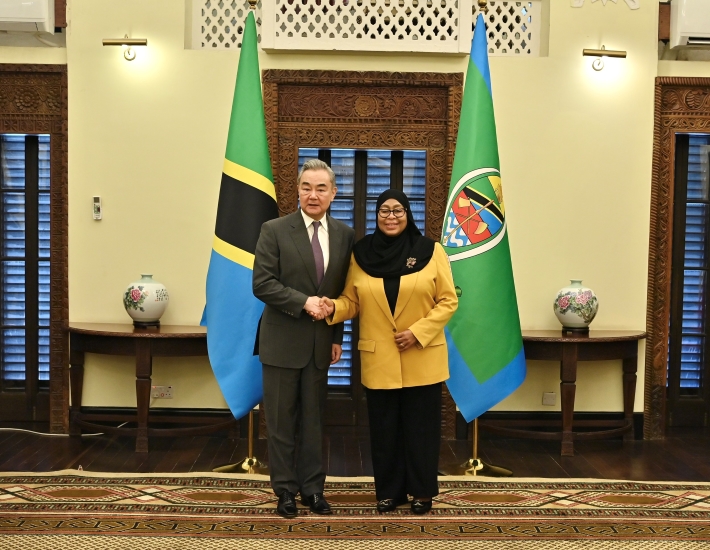
Similarly, Tanzania experienced domestic political tensions and diplomatic difficulties in 2025 following disputes related to its general election. Wang’s visit to Tanzania sent a clear signal of China’s unwavering support for Tanzania in pursuing a modernisation path suited to its national conditions. It also provided timely encouragement and confidence for Africa as it continues to explore a course of independent and self-reliant development.
Shared development
The year 2026 is a critical one for the full implementation of the outcomes of the 2024 Forum on China-Africa Cooperation (FOCAC) Beijing Summit. Wang’s visit to Africa is aimed at deepening strategic alignment and strengthening policy coordination with African partners, as both sides jointly explore practical pathways towards modernisation. As a steadfast companion on Africa’s journey towards modernisation, China has responded with concrete actions to Africa’s aspirations for industrialisation and economic autonomy. It has continued to expand unilateral opening-up to Africa, granting zero-tariff treatment on 100 percent of tariff lines for products from 53 African countries with diplomatic relations with China. This policy has been widely welcomed by African business communities as a “golden ticket” to the Chinese market.
Statistics show that Africa’s exports to China have registered rapid growth over several consecutive years due to a lowering or elimination of tariffs. High-quality agricultural products such as coffee, nuts and avocados have gained growing popularity among Chinese consumers, generating tangible income opportunities for African farmers and small- and medium-sized enterprises. This approach enhances Africa’s development capacity and has a multiple effect on livelihoods. During this visit, “zero tariffs” emerged as the most talked-about term among African counterparts. Zero-tariff treatment, as an integrated trade and investment measure, is expected to further support Africa’s efforts to expand exports, attract investment and create jobs, while catalysing cooperation in emerging sectors such as green industries, e-commerce and digital payments, science and technology, and artificial intelligence. China’s vast market will truly become Africa’s great opportunity.
China-Africa development cooperation has now entered a phase of qualitative improvement. From the Initiative on Cooperation Supporting Modernisation in Africa to the Plan for China Supporting Africa’s Agricultural Modernisation, China has rolled out a series of cooperation frameworks that closely align with the AU’s Agenda 2063. By the end of 2025, China-built economic and trade cooperation zones in Africa had created more than 400,000 local jobs, while China’s stock of direct investment in Africa exceeded $50 billion, spanning manufacturing, the digital economy and green development. In places such as the Eastern Industrial Zone in Ethiopia and the Chambishi Industrial Park in Zambia, large numbers of young Africans have grown into skilled workers and managers, marking a shift from external support to endogenous, self-driven development. In addition, the advancement of the revitalisation of the Tanzania-Zambia Railway is expected to foster a “railway-driven prosperity belt,” injecting new momentum into regional connectivity and industrial development.
Focus on friendship
Amity between the people holds the key to sound state-to-state relations. The launching ceremony of the 2026 China-Africa Year of People-to-People Exchanges was held on 8 January at the AU headquarters in Addis Ababa, the capital of Ethiopia. Wang read out President Xi’s congratulatory message and delivered a keynote address. Remarks were also made by Jean-Claude Gakosso, foreign minister of the Republic of the Congo and the African co-chair of FOCAC, AU Commission Chairperson Mahmoud Ali Youssouf, and Ethiopian President Taye Atske Selassie.
This high-profile event, attended by senior officials from the AU and diplomats from African countries, reflected the great importance both sides attach to the China-Africa Year of People-to-People Exchanges. Its launch marked a new stage in bilateral relations, moving towards deeper people-to-people connectivity and shared cultural prosperity. The story of China-Africa friendship is written not only in official documents, but also woven into the daily lives and emotional bonds of the two peoples.
This edition of the China-Africa Year of People-to-People Exchanges features nearly 600 diverse activities divided into different segments. The Power of Youth segment will focus on China-Africa youth innovation and entrepreneurship competitions as well as youth leaders’ dialogue forums. Activities in the Cultural Kaleidoscope segment will promote touring performances by African art troupes in China and introduce Chinese cultural and creative products to Africa. Under the digital empowerment programme, new technologies such as artificial intelligence will be used to develop immersive language-learning and cultural experience projects. These initiatives emphasise two-way engagement, equality and youth participation, aiming to make exchanges truly dynamic and impactful, especially by inspiring the younger generation to become inheritors and pioneers of China-Africa friendship.
Africa is now brimming with vitality, with accelerating integration and an increasingly prominent role on the global political and economic stage. China, meanwhile, is advancing its development through Chinese modernisation. The strategies of both sides are highly aligned, opening up unprecedented space for cooperation.
Guided by the vision of building a community with a shared future for mankind, and under the principles of sincerity, real results, amity and good faith, China and Africa will work together to usher in a new era of shared development and make even greater contributions to the noble cause of peace and progress for humanity.
The authors are Assistant Research Fellows from Department for Developing Countries Studies, China Institute of International Studies
