
A Transformative Masterpiece
In the Kigongo area of Mwanza Region, northwest Tanzania, fishmonger Neema Aisha remembers how the morning’s fresh catch would sour while she queued for the ferry, putting her business at risk.
“I struggled daily with fish spoiling in the harsh sun and the moisture from melting ice, which posed a constant threat to my livelihood,” Aisha told ChinAfrica.
But today, as Aisha steers her pickup across the Chinese-built Magufuli Bridge which connects Kigongo (in the Mwanza Region) and Busisi (in the Geita Region), a cool breeze and the steady hum of traffic set a soothing tone for her morning.
Aisha now benefits from insulated containers that keep her fish fresh during transit, ensuring they arrive at the market in Sengerema District still glistening and of high quality. The bridge has significantly shortened her travel time and provided her with a sense of security and control over her business operations.
“My fish stock now arrives fresh and timely. This has significantly reduced the stress and losses associated with goods getting stuck in ferry queues or delays, thereby improving my clients’ satisfaction and reliability of supply.”
Baba Juma, a coffee vendor in Busisi Town, shares the sentiment. He once spent his mornings anxiously watching the aroma of freshly roasted beans fade as he waited in the ferry queue.
“As the sun climbed, my profits dropped. But today, my mornings are different! I feel the cool grip of the steering wheel and hear the confident hum of my engine as I glide onto the bridge,” Juma told ChinAfrica.
“I no longer feel the frustration of wasted time,” he said. “Instead, there’s a calm, focused energy, knowing my business moves as fast as the traffic on this majestic new structure.”
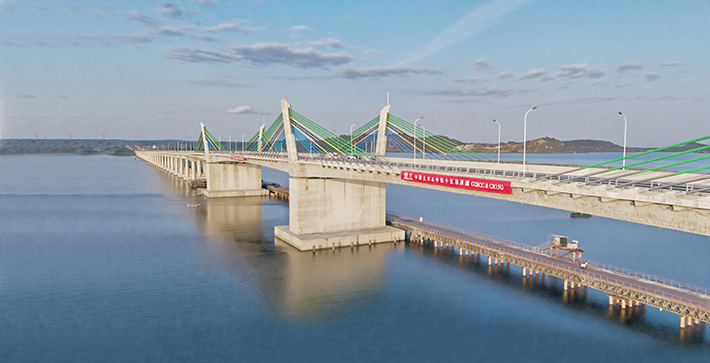
Before the bridge, ferry delays caused operational inefficiencies and economic losses for entrepreneurs, a consequence of inadequate infrastructure. What was once a vast expanse of shimmering water now thrums with twin white towers piercing the Tanzanian sky like sentinels.
But for entrepreneurs in Mwanza district, the Magufuli Bridge (also known as the Kigongo-Busisi Bridge) is more than a colossal ribbon of steel and concrete. It is a tangible symbol of opportunity, turning the city’s daily struggles into tangible success.
Connectivity dividends
Across Lake Victoria, the Magufuli Bridge marks a milestone in Tanzania’s infrastructure development. At 4.66 km long, with a 520-metre extradosed cable-stayed span, it holds the title of Africa’s longest bridge of its kind. Built as a four-lane dual carriageway designed for high-speed traffic, it links the towns of Kigongo and Busisi, transforming the corridor into a strategic hub set to energise trade, tourism and agriculture across the region.
Tanzania’s Minister of Works Abdallah Ulega called it a project of historic significance during a recent tour. It was built with an investment of more than TZS700 billion ($282 million) by the government. Ulega said this milestone marks a transformative step in East Africa’s infrastructure development as the Tanzanian government fully financed the project, demonstrating the country’s commitment to self-financing its major infrastructure projects.
With its promise of improved mobility, enhanced trade and stronger regional ties, Tanzanian President Samia Suluhu Hassan has described the bridge as a milestone infrastructure project in the country.
“The state-of-the-art bridge will reduce the travel time across Lake Victoria from two hours to five minutes and will also help to boost trade with neighbouring countries like Uganda, Rwanda, Burundi and the Democratic Republic of the Congo,” Hassan said during the inauguration on 19 June 2025.
Arguably, the Magufuli Bridge stands as a symbol of progress and possibility for Tanzania and East Africa at large, as it not only honours the legacy of the late president’s infrastructure-focused leadership, but also sets a benchmark for future projects across the continent.
Speaking at the same inauguration event, Chinese Ambassador to Tanzania Chen Mingjian, affirmed that the Magufuli Bridge is a landmark project under the Belt and Road Initiative.
“This is a model of China-Tanzania cooperation, highlighting its broader significance for China-Africa development,” Chen stated.
Constructed by China Civil Engineering Construction Corp. (CCECC) and China Railway 15th Bureau Group, the bridge features advanced engineering techniques, including cantilever casting of 123 segments, supporting high-speed traffic and heavy loads.
Engineers say the design not only highlights cutting-edge construction methods, but also ensures the bridge can handle high-speed traffic with precision and safety, standing as a striking testament to modern bridge engineering in Africa.
Changing lives
The bridge is expected to boost surrounding industries, including agriculture, tourism and commerce, benefitting over 1 million residents around Lake Victoria. “This drastically lowers cross-lake transport costs by 10 to 15 percent,” CCECC recently noted.
For Raphael Ndagala, a taxi driver operating on the Busisi-Mwanza route, the bridge means more than just a faster journey; it also opens a new business territory. Ndagala said that before, Kigongo felt like a distant, unprofitable area, but now, as he drives across the bridge, he sees a continuous flow of opportunity. “I no longer fear the jarring stop-and-go of the ferry lines,” he noted.
Ndagala is upbeat that the bridge’s gleaming white towers serve as a beacon for new customers and fares, while the sound of his phone chiming with ride requests from across the creek has become a regular, welcomed melody.
“I no longer feel the pressure of a limited customer base, but the liberating thrill of an open road - a future with no boundaries!”
