
2026 World Artificial Intelligence Conference & High-Level Meeting on Global AI Governance and the World AI Cooperation Organization
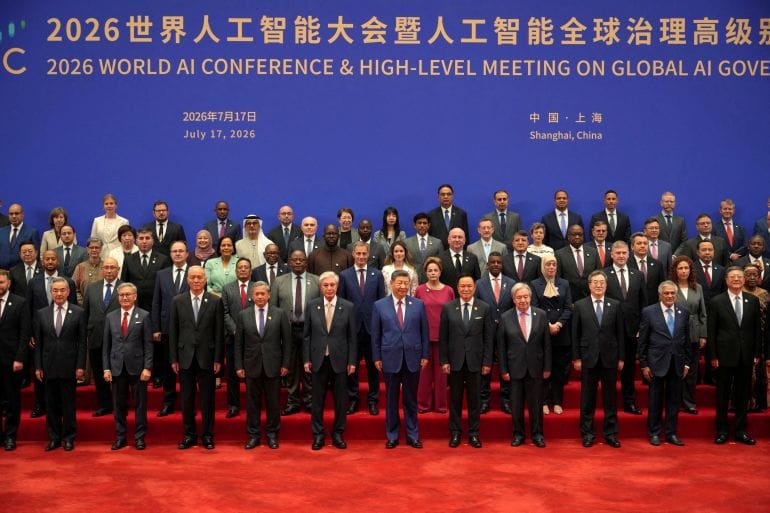
The 2026 World AI Conference (WAIC) and High-Level Meeting on Global AI Governance was held in Shanghai, China during 17 to 20 July. Chinese President Xi Jinping attended the opening ceremony on 17 July and delivered the keynote address.
Kazakh President Kassym-Jomart Tokayev, Cambodian Prime Minister Hun Manet, Thai Prime Minister Anutin Charnvirakul and Secretary-General of the United Nations Antonio Guterres delivered speeches at the opening ceremony.
.jpeg)
President Xi Jinping Delivers Keynote Address
On the morning of July 17, 2026, President Xi Jinping attended the opening ceremony of the 2026 World AI Conference and High-Level Meeting on Global AI Governance at the Grand Halls in Shanghai and delivered the keynote address .
1. President Xi shared four observations on AI development and governance
First, we should adhere to the principle of openness and win-win and boost innovation-driven development.
Second, we should strengthen risk-awareness and ensure that AI is secure and controllable.
Third, we should encourage inclusiveness and promote mutual learning between civilizations.
Fourth, we should advocate solidarity and improve global governance.
2. President Xi announces major measures to further support global AI development and advance global AI capacity building
In the next five years, China will provide developing countries with 5,000 opportunities in AI training and seminar programs; develop international AI application cooperation centers with the Association of Southeast Asian Nations, the League of Arab States, the African Union, the Community of Latin American and Caribbean States, the Shanghai Cooperation Organization, and BRICS; and enable 30 countries to use the AI-powered meteorological warning system, or MAZU, to safeguard homes around the world.
The World AI Cooperation Organization (WAICO)
On July 16, the Signing Ceremony of the Agreement on the Establishment of WAICO was held in Shanghai. On behalf of the Chinese government, Member of the Political Bureau of the CPC Central Committee and Minister of Foreign Affairs Wang Yi attended the ceremony and signed the agreement.
Representatives from 29 countries, including South Africa, Kazakhstan, Laos, Pakistan, Russia and Indonesia, signed the agreement, with these countries becoming founding members of the Organization. UN Secretary-General António Guterres and representatives of other countries and international organizations attended the ceremony.
As President Xi Jinping noted in his keynote speech on 17 July ( read the full speech below) , AI development should not be a solo performance by a single country, but a symphony of international cooperation. Thanks to our joint efforts, WAICO has come into being in Shanghai. Our vision from one year ago is now a reality. This is a major move by China to answer the call of the Global South and unite the international community together to promote vigorously AI development and governance. It will be an important milestone in the history of AI development.
According to the Chair's Statement of the Conference , WAICO will be the world's first intergovernmental international organization on AI, with its Headquarters located in Shanghai.
Upholding the principle of AI for good and for all, WAICO aims to bridge the AI divide by supporting Global South countries in accelerating AI development, strengthening comprehensive capacity in innovation, application and governance, and keeping pace with scientific and technological revolution.
WAICO will be guided by a set of fundamental principles: upholding the purposes and principles of the U.N. Charter, respecting the sovereignty of countries and the diversity of civilizations, adhering to equality, practicing multilateralism, committing to extensive consultation and joint contribution for shared benefit, and enabling win-win cooperation.
WAICO shall be open to all countries, and maintain communication with other international organizations to explore appropriate forms of cooperation.
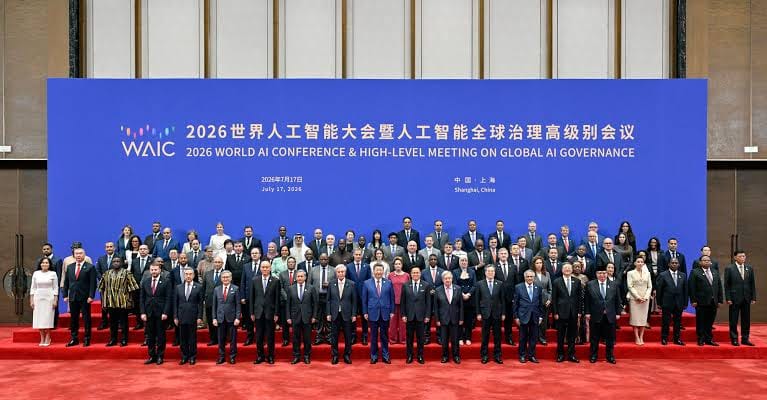
Minister Blade Nzimande's Official Visit to China
Minister of Science, Technology and Innovation of the Republic of South Africa, Prof. Blade Nzimande, kicked off his official visit to the People's Republic of China on Tuesday, 15 July.
On 16 July, Minister Nzimande signed the Agreement on the Establishment of the World AI Cooperation Organization (WAICO) on behalf of South Africa, marking that South Africa becomes a founding member of the WAICO.
Minister Nzimande attended the 2026 World AI Conference and High-Level Meeting on Global AI Governance in Shanghai from 17 to 20 July. He delivered a speech on 18 July on the High-Level Meeting.
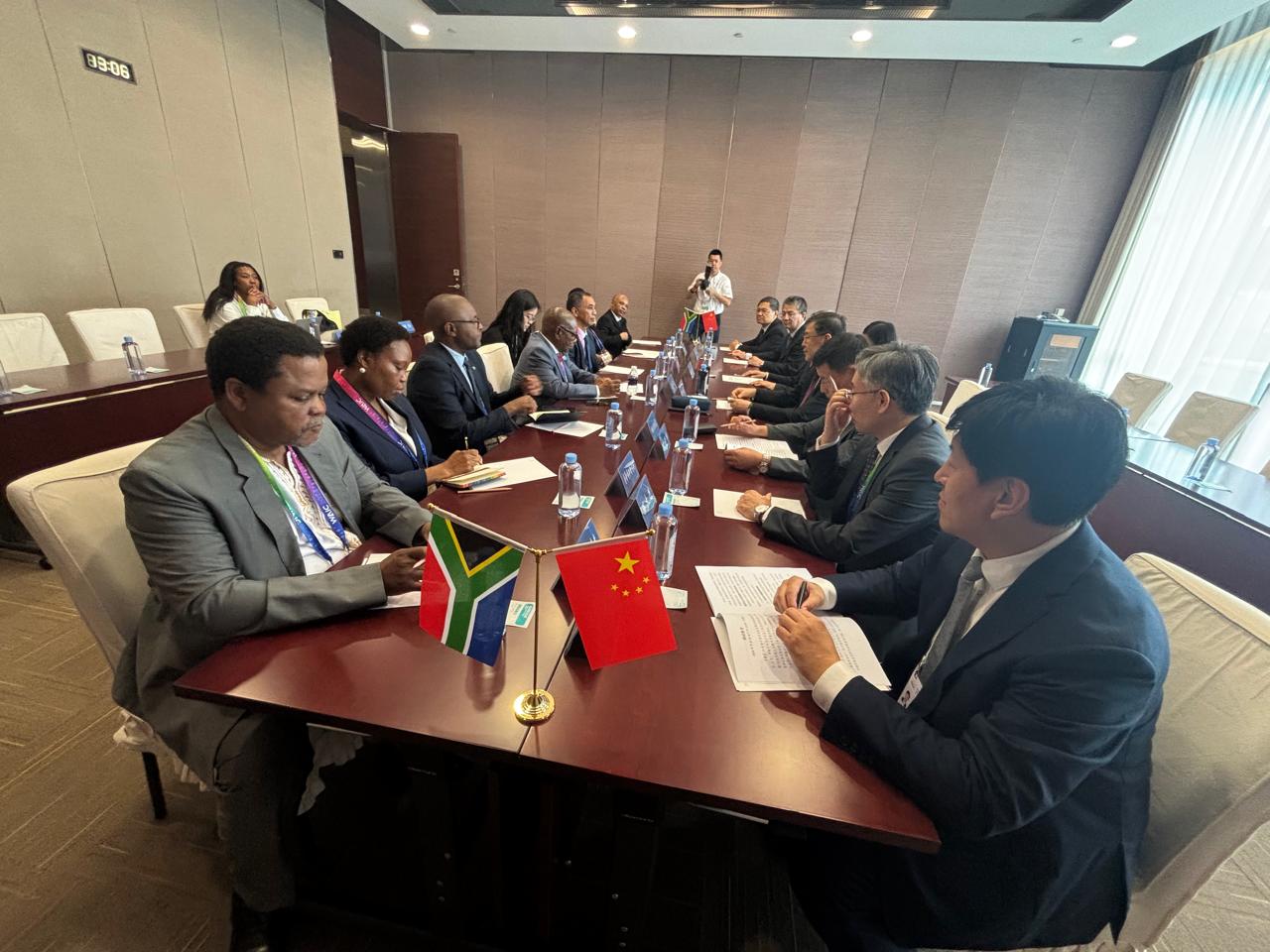
Minister Nzimande held a high-level meeting his counterpart, Mr. Yin Hejun, the Chinese Minister of Science and Technology.
.jpeg)
Joining Hands to Build a Just and Equitable System
For Global AI Governance
Keynote Address by H.E. Xi Jinping
President of the People’s Republic of China
At the Opening Ceremony of the 2026 World AI Conference and
High-Level Meeting on Global AI Governance
Shanghai, July 17, 2026
Distinguished Colleagues and Guests,
Ladies and Gentlemen,
Friends,
Seventy years ago, a group of young scholars proposed the concept of artificial intelligence (AI) for the first time at the Dartmouth Workshop in New Hampshire of the United States. In the subsequent 70 years, AI scientists and researchers from around the world ventured into this unknown territory, forged ahead through twists and turns, and made breakthroughs with persistent hard work. Seven decades later today, amid the new wave of AI development, we are gathering by the Huangpu River to discuss how to promote AI globally for the positive, for good and for humanity. All this makes our meeting highly important. On behalf of the Chinese government and people, I would like to extend a warm welcome to you all.
In the course of history, the invention of the steam engine heralded the industrial civilization, the widespread access to electricity brightened up modern society, and the birth of the Internet brought the entire world together. Each of these technological revolutions has profoundly reshaped our way of work and life, and enabled a giant leap in economic and social development.
Today,major changes unseen in a century are accelerating across the world. The new round of technological revolution and industrial transformation is advancing at a faster pace, and the world has entered an unprecedented period of active innovation on AI technologies. Intelligent connectivity, human-machine collaboration, cross-sector integration, joint creation and sharing, and other intelligent technologies are unleashing enormous power. All this carries within it great opportunities as well as challenges to governance. We human beings must answer the questions posed by our times: How to get along with thinking machines? How to ensure security when algorithm is part of decision making? How to tackle ethical challenges by technologies through adaptive governance? How to realize AI for all when the divide keeps widening? These questions demand serious consideration and real answers from the whole international community.
In China’s view, all countries should take a people-centered approach and develop AI for the positive and for good. We should ensure that AI is an important driver for shared prosperity and common security. We should join hands to build a just and equitable system for global AI governance. To this end, I wish to share four observations.
First, we should adhere to the principle of openness and win-win and boost innovation-driven development. As a new engine of world economic growth and an accelerator for the shift of growth drivers, AI is moving from the digitalworld into the physical world. We should seize this rare, historic opportunity to encourage open source, openness, collaboration and sharing. We should facilitate technological innovation, industrial development and scenario-based application of AI. We should make coordinated advances in the transformation and upgrade of traditional industries, the cultivation and growth of emerging industries and forward-looking planning for future industries, so that all sectors and businesses can benefit from AI.
Second,we should strengthen risk-awareness and ensure that AI is secure and controllable. AI should be a trusted tool for humanity. We should take seriously the various types of inherent and secondary risks that AI may trigger. We should put in place laws and regulations, technological monitoring,early warning and emergency response systems in order to strengthen the line of security, prevent abuses and malicious use, and ensure that AI is always under human control. In the meantime, we should jointly oppose over stretching the national security concept in the field of AI and placing one country’s security over that of others.
Third, we should encourage inclusiveness and promote mutual learning between civilizations. AI development and its application should not erode or undermine the diversity of world civilizations or the uniqueness of cultures of different countries. We must shape the values of AI with humanity’s common values, and make good use of AI technologies to increase understanding, tolerance,exchanges, and sharing among all civilizations. We should tend to the garden of civilizations with great care to ensure that the beauty of each civilization is appreciated and shared.
Fourth,we should advocate solidarity and improve global governance. AI is an invaluable asset that encapsulates humanity’s collective wisdom. We should practice true multilateralism and recognize the important role of the United Nations. We should enhance alignment and coordination on AI development strategies, governance rules and technical standards, so as to form a consensus-based global governance framework at an early date to make this frontier technology better benefit humanity. We must carry out extensive international cooperation and help Global South countries with capacity building to bridge the AI and digital divides, promote sustainable development,and prevent creating new historical injustice in AI.
Ladies and Gentlemen, Friends,
This year marks the start of China’s 15th Five-Year Plan. It maps out China’s economic and social development for the next five years and provides immense opportunities for the international community. In recent years, China has embraced AI with open arms. We have promoted interplay between an efficient market and a well-functioning government, strengthened AI innovation, actively advanced the AI Plus Initiative, and built a healthy ecosystem for all entities to thrive in together. The core smart economy industries are worth at least RMB 1 trillion yuan. Smart devices in countless homes truly improve people’s livelihood. Intelligent Manufacturing in China has become another shining hallmark of Chinese modernization.
At the same time, China lays great emphasis on safety and security in AI development. With a deep understanding of the trends and logic of AI development, we are continuously improving laws, regulations, policies, mechanisms, application norms, as well as ethical principles to make sure that AI is safe, secure and controllable, and that this fine steed of AI gallops with both speed and stability.
As a reponsible major country, China is always committed to providing international public goods relating to AI. Since I proposed the Global AI Governance Initiative, China has promoted the adoption of the U.N. General Assembly Resolution on Enhancing International Cooperation on Capacity Building of Artificial Intelligence by consensus, published the AI Capacity Building Action Plan for Good and for All, announced the AI Plus International Cooperation Initiative, and advocated for establishing the World Artificial Intelligence Cooperation Organization (WAICO). China has been contributing steadily to the global AI governance.
We often say in China, “A single string cannot make music, and a single tree does not make a forest.” AI development should not be a solo performance by a single country, but a symphony of international cooperation. Thanks to our joint efforts, WAICO has come into being in Shanghai. Our vision from one year ago is now a reality. This is a major move by China to answer the call of the Global South and unite the international community together to promote vigorously AI development and governance. It will be an important milestone in the history of AI development.
To further support global AI development and advance global AI capacity building, I hereby announce that in the next five years, China will provide developing countries with 5,000 opportunities in AI training and seminar programs; develop international AI application cooperation centers with the Association of Southeast Asian Nations, the League of Arab States, the African Union, the Community of Latin American and Caribbean States, the Shanghai Cooperation Organization, and BRICS; and enable 30 countries to use the AI-powered meteorological warning system, or MAZU, to safeguard homes around the world.
Ladies and Gentlemen, Friends,
As ancient Chinese observed, “A man of wisdom adapts to changes; a man of knowledge acts by circumstances.” With AI advancing at a staggering speed, we must ensure its development is for the positive, for good and for humanity. We must make its oversight and governance precise and effective, and constantly refine measures to forestall loss of control. We should always guide AI development with human wisdom and international consensus, so that AI can truly become a mighty force that increases the well-being of humanity and advances human civilization.
China is ready to be more open, take more practical actions, and assume a more visionary perspective. We are ready to work with all parties to seize the opportunities of AI development and meet the challenges, and join hands to create a brighter future for humanity.
Thank you!
Chair’s Statement of the 2026 World Artificial Intelligence Conference & High-Level Meeting on Global AI Governance
July 17, 2026
The 2026 World Artificial Intelligence Conference & High-Level Meeting on Global AI Governance was held in Shanghai, China from July 17 to 20.President Xi Jinping of the People’s Republic of China attended the opening ceremony of the Conference and delivered the keynote address. The event was attended by President Kassym-Jomart Tokayev of the Republic of Kazakhstan,Prime Minister Hun Manet of the Kingdom of Cambodia, Prime Minister Anutin Charnvirakul of the Kingdom of Thailand, Secretary General of the United Nations António Guterres, and official representatives, business leaders,scholars and researchers from more than 100 countries and international organizations. At this important moment in history of rapid global AI advancement, the Conference was convened under the theme “AI Partnership for a Brighter Future” and discussed pathways to promote global AI development for good and for all.
The Conference noted that AI is completely reconfiguring economic and social development, and will have a profound impact on the progress of human civilization. Both the opportunities and challenges accompanying AI are growing. On the one hand, its deep integration in industries, daily lives and scientific research is boosting economic transformation, technological breakthroughs and efficiency. On the other hand, its continuous iterations are bringing to the fore questions about technology ethics, data security and regulatory frameworks.
The Conference recognized that AI is a new subject in global governance that requires a new paradigm to be developed through international coordination in the spirit of global solidarity. The Conference stressed the need to strike the right balance between development and security, innovation and governance, and national interests and global well-being, and outlined the principles of people-centered approach, AI for good, fairness and inclusiveness, and collaborative governance. The conference called for more robust international cooperation to share ideas and shape solutions on the major issues and pressing challenges facing humanity in the era of AI and giving prominence to international cooperation on AI capacity-building in global AI governance. The conference also called for urgent actions on outstanding issues such as the uneven distribution of resources and unfair distribution of power, with a view to enabling Global South countries to benefit equally from AI development, advancing the United Nations 2030 Agenda for Sustainable Development and ensuring AI truly benefits all humanity.
1. Innovation is the core driving force behind AI development. We advocate fostering an innovation ecosystem that is enterprise-led, market-driven, application-oriented, research-grounded and talent-based. Humans play a key role in AI development. We must give high priority to fostering AI professionals with digital proficiency, humanistic grounding, innovative thinking and a global perspective.
2. We should advance AI empowerment across industries and in households. AI holds significant empowering potential. We should actively promote an AI+ model to stimulate global innovation, explore new paradigms of scientific research, and create new forms of smart economy. We should develop a new model of token economy built on large language models and led by AI agents. We should leverage AI to transform and upgrade traditional industries, foster and strengthen emerging industries, and plan for industries of the future. We should advance AI application in various fields such as science,education, industry, agriculture, health, transportation, climate, the environment, and government services.
3. Open source and openness are vital pathways to the inclusive AI development. We should encourage in a responsible manner the joint development of open-source ecosystems, actively develop open and inclusive international open-source communities, respect the independent choices of enterprises, promote the sharing of AI-related research outcomes and technical experience on the basis of sound intellectual property protection,and enhance the accessibility of AI technologies and services.
4. Data plays an important role in AI development. We should recognize the highly fluid and empowering nature of data, deepen the development and utilization of data resources, safeguard data security, jointly strengthen the protection of personal information and move faster to create foundational institutions such as data property rights, so as to ensure that data is manageable, controllable and traceable, thereby promoting its secure and orderly flow and efficient development and use.
5. We should promote the development of sustainable AI and boost the deep integration of AI and energy systems. We should better coordinate and match computing power load with electricity supply by deploying large-scale intelligent computing clusters in regions rich in new energy resources. We should monitor AI’s energy and environmental impact, advance its green and low-carbon development, and promote the mutual empowerment of AI and energy development.
6. We should pay attention to the impact of AI technology on social transformation, systemically assess and respond to its impact on employment structure, harness its potential in job creation, actively provide AI education and skilling, energize society-wide innovation and entrepreneurship, and effectively safeguard worker’s rights and dignity to foster a smart society more aligned with human values.
7. We should be mindful of the security risks posed by AI, actively promote the development of laws and regulations, technical monitoring, risk warning and emergency response systems, stay risk-oriented and pursue agile governance, explore tiered and category-based management, secure the bottomline of security, prevent the abuse and malicious use of AI, and ensure that AI always remains under human control.
8. The upgrading of frontier AI technologies has complex implications for the security of and in the use of ICTs, and poses potential threats to critical infrastructure in finance, electricity, telecommunications and transportation. Global leading AI enterprises should advance R&D with prudence, equip large language models with necessary guardrails, ensure the safe deployment of frontier models, and guard against the systemic risks caused by AI.
9. AI agents, as new forms of AI products and services, must operate with clearly defined decision-making authority and behavioral boundaries and mechanisms for behavior tracing and risk alert. It is of special importance to enhance their endogenous security capacity, and address the risks derived from their application.
10. We should jointly prevent and fight against the abuse and malicious use of AI technologies by terrorist and extremist forces, and transnational organized criminal groups, and establish necessary crisis management and emergency response mechanisms on a global scale.
11. We should practice true multilateralism, play the central role of the U.N. in global governance, pay attention to the fragmentation of global AIgovernance, and support the U.N. Global Dialogue on AI Governance and the Independent International Scientific Panel on AI in playing their due roles, soas to further consolidate global consensus, share best practices, and ensure equal rights, opportunities and rules for all countries.
12. We should consider formulating international economic and trade rules for AI, promote inclusive cooperation on AI industrial and supply chains,support developing countries’ greater participation in the global division oflabor, and ensure fair participation in global competition by enterprises from all countries, and preserve the stability of AI industrial and supply chains.
13. In light of the serious stagnation in progress toward the U.N. SDGs, it is important to persist in implementing the U.N. General Assembly Resolution on Enhancing International Cooperation on Capacity-building of Artificial Intelligence, conduct pragmatic collaboration based on the real needs of developing countries, support countries in unlocking their own potential and unique strengths, and share in the dividends of AI development.
14. We should accelerate the formulation and revision of security,industrial and ethical standards, and establish a framework of standards and norms that is consensus-based, scientific, transparent and inclusive, with due consideration of technological progress, risk prevention and social ethics. We should facilitate mutual recognition of standards among countries, and lower the costs and thresholds of international AI cooperation.
15. We should respect the differences in histories, cultures, social systems and forms of civilization across all countries, and protect the world’s cultural diversity. We should advance the adaptation of AI technologies to diverse cultural scenarios, promote the creative transformation and innovative development of cultures of different countries, and uphold the diversity of world civilizations and the uniqueness of national cultures.
During the Conference, the signing ceremony of the Agreement on the Establishment of the World Artificial Intelligence Cooperation Organization(WAICO) was held in Shanghai. WAICO will be the world’s first intergovernmental international organization on AI, with its Headquarters located in Shanghai. Upholding the principle of AI for good and for all, WAICO aims to bridge the AI divide by supporting Global South countries in accelerating AI development,strengthening comprehensive capacity in innovation, application and governance,and keeping pace with scientific and technological revolution. WAICO will be guided by a set of fundamental principles: upholding the purposes and principles of the U.N. Charter, respecting the sovereignty of countries and the diversity of civilizations, adhering to equality, practicing multilateralism, committing to extensive consultation and joint contribution for shared benefit,and enabling win-win cooperation. WAICO shall be open to all countries, and maintain communication with other international organizations to explore appropriate forms of cooperation.
